Saturday, August 29, 2020

Empty suit


Back in the day, project leaders wore something more than 'business casual'. Both men and women dressed for their roles.

But, alas, some of these "suits" [including ladies' attire] were 'empty'. If there were informing principles that guided policy and decisions, they only seemed to emerge when the consensus was already formed.

It was frustrating to work for those people.
A line from the play "Hamilton" is apt, and the issue is centuries old:

If you stand for nothing, what will you fall for?
Well, actually, there's no way of knowing the answer. And so these are not only frustrating people to work with, they can also be dangerous, pulling the rug out, failing to support, and reversing course without notice.

Where you sit
I think this is a bit different -- yet, not that much different -- from the similar adage: 
"Where you stand depends on where you sit".
That bit of wit is more about taking responsibility for consequences. When you don't have such, you can say anything. You may think you stand on principle, but it's harder when you're accountable for the consequences of your actions. You may find a tactical compromise will actually advance your strategic principle.

It's still frustrating, but we see it all the time. Responsibility, authority, and accountability shape things differently and bring realism to theory.


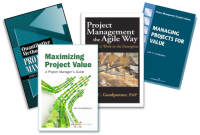
Buy them at any online book retailer!
Wednesday, August 26, 2020

Pyramid v Funnel


In every book written about project management, the PMO is at the apex of a pyramid. Sometimes, as in Agile project methodology, the pyramid is flatter than most, but always there is an identifiable top figure.

Fair enough.

But Robert Gates, former Defense Secretary [and holder of many other government titles] writes that he often felt like the pyramid was inverted and thus took the look of a funnel. In the funnel model, the 'decider' is at the bottom of the funnel, with others pouring stuff in. 
 
Funnel v. Pyramid
How can it be that the top person is at the bottom, figuratively?

Gates explains: in the pyramid model, stuff is either pushed up for political cover, or because protocol demands that the decision lies higher, or because the apex person is pulling stuff up that they want control or inspection of

But in the funnel model, the top person is like the paper at the bottom of the bird cage: everything is pouring in from the top; and everybody on the project is busy doing the pouring. Fortunately, only a bit funnels all the way through, but gravity seems to be in charge. It's inexorable.

Filters in the funnel
Fortunately, the funnel can work like the pyramid, only with gravity. There can be and should be filters in the funnel. The minor stuff is trapped early and doesn't make it through. The top person -- at the end of the funnel -- can pull stuff "down", and there is some gravity effect: stuff naturally falls to the bottom for action.

And so for the PMO, the management points are:
  • In the funnel model, things move by default. There's an expectation on the part of anyone pouring stuff in at the top that it will eventually come to the attention of those 'at the bottom of the funnel'. Gravity is just the consequence of applying energy to get stuff up to the top of the funnel and pouring it in.

  • But in the pyramid model, gravity works against you. The default is: nothing moves to the top. If you want it to move up, there's work to be done!

If you like the idea of a funnel, how would you create it?
Just open your door! The funnel model is somewhat like "my door is always open" (even if virtual) ; anyone can "pour" something in. 
 
But, rather than "anyone can", you move to "everyone should" pour something in. As the 'decider' you don't have to pull very much in if you operate like a funnel; stuff will get to you. If you like the funnel effect, you say that's good.
Perhaps, but only if you have the methods, tools, discipline, and staff to sort it out.

If you don't, turn things upside down and operate like a pyramid. Gravity is your friend; a lot of stuff just won't rise to the top.


Buy them at any online book retailer!

Sunday, August 23, 2020

Join the project from your childhood bedroom


It seems bizarre to think about it, but newbies to the workforce, and thus new to the project, may be working from home from the very desk they used in the 7th grade.

This jarring possibility is discussed in a news article wherein some of the hazards we've all thought about are put in the context of working from the bedroom you grew up in.
  • There's a professional atmosphere that's missing if you're surrounded by your high school stuff (Suggestion: redecorate for adult business)
  • The 'welcome-on-board' ritual -- done virtually -- may be more limited and less engaging.
  • You may not meet your project or team leader in person for a long time (working in different cities, etc) -- or ever!
  • From your old bedroom, you may not appreciate or share a culture that others acquired when the workplace was physical. But not to worry: that "physical-dominated culture" will fade over time if virtual is the new normal.
  • Opportunities to connect personally and form relationships that will help your career and help shape your future may be deferred
  • You may have been a leader in high school, but opportunities to demonstrate leadership early on -- as a professional --  may be more limited
And, if you are sitting on your bed waiting on a government clearance:
Waiting alone rather than in a group can be not only boring in the extreme, but, as a practical matter, it will be hard to not fall through the crack with others with whom you should be connecting.

(Suggestion: show initiative and ask for an unclassified task to do, and a mentor with whom to work on the task)

Yikes! Is all this the new normal, or just a passing nightmare?


Buy them at any online book retailer!

Thursday, August 20, 2020

Assessing risk


Most of us -- that is, all but the few formally trained in risk assessment -- really suck at risk assessment, a necessary first step toward managing risk.

Why so?
Bias, for one thing. Confirmation bias being a biggie: we all want confirmation that our thinking, experiences, and instincts are right for the situation we find ourselves in. But, of course, we know objectively, even if not internalized well, that confirmation bias is one we want to avoid.

Optimism, for another. We don't apply objective analysis very well. The "cone of uncertainty" that PMs read about so often is really a cone of optimism. The further out in time, the more we assess a risk optimistically. For one thing, objectively we can say there is more opportunity, given time, to do something to mitigate risk. So why not be optimistic?

Along with optimism and opportunity, add a sense of control. If there's time to react, to study alternatives, and to experiment with mitigation, then of course we can rightfully feel in control of the situation. The reality may be, however, that things are out of control and we just can't accept that idea.

Accept it, and move on
And, then of course, there is the number one thing you can do about a risk: ignore it! Most are inconsequential in the big picture, and so ignoring them is justifiable as a way of only keeping the important stuff in front of you.

And, so ignoring the risks in front of you, you may convince yourself you can live with the risk, as most of us do with most of what we confront day-to-day. But, of course, you could be quite wrong: living with the risk may well be the worst thing you can do.

You'll have to think it through to know, of course.


Buy them at any online book retailer!

Monday, August 17, 2020

National Research Cloud


From the press
Leading universities and major technology companies agreed on [in late June, 2020] to back a new project intended to give academics and other scientists access to the computing resources now available mainly to a few tech giants.

The initiative, the National Research Cloud, has received bipartisan support in both the House and the Senate. Lawmakers in both houses have proposed bills that would create a task force of government science leaders, academics and industry representatives to outline a plan to create and fund a national research cloud.

This program would give academic scientists access to the cloud data centers of the tech giants, and to public data sets for research


For many PMOs, a large-scale data warehouse of research artifacts is simply out of reach. Likewise, the large-scale computing power necessary for "deep" learning and training is often beyond the pale.

But, possibly no more.Whereas the largest tech companies can collectively spend billions on data centers and their operations, few outside that community can afford to participate.

Depending on how the rules are set up for access and payment, it may be possible for the lesser funded private and university labs to get in the game. Let's hope so!


Buy them at any online book retailer!

Friday, August 14, 2020

Need to know


Two questions:
  1. Do you need to know?
  2. Why do you need to know?

There are a lot of PMOs that deal with government classified specifications and classified contractor-agency relationships, or deal with private or proprietary information; or even legal client-attorney privileged information.  Sometimes it's privileged HR stuff. And sometimes, there is a combination of all of the above.

Fair enough; most of us have had some experience with such project security.

Don't you trust me?
But, here's the issue that can really strain the seams in the PMO:
  • Who gets to know; 
  • Who is in the know;
And, if you are not "in the know" what does that mean? Does it mean you don't trust me? Trust underpins every relationship in the PMO, so how could there be a working PMO if trust is in question?
It's not about trust
The short answer is: it's not about trust. I can trust you absolutely, but still not convey information you don't need.

Often, there is a clash between clearance, compartmentalization, channels, and trust.
  • Clearance: It's all about grading or classifying the harm, if information is disclosed. If you've got "clearance" for certain classifications of information, it means two things: first, you can be trusted to keep to yourself information with that level of harm (if disclosed), and, second, you're not vulnerable to attack by nefarious seekers.

    But, it doesn't mean anyone is going to give you that information just because "you are cleared". You have to get over the hurdle of "having a need to know".
  • Compartmentalization: It's all about controlling who gets to know by putting some information in a compartment or vault (virtual or physical) for which the entry is strictly by invitation.
    And, sometimes the compartment is "black", meaning its mere existence is "denied". You'll need a special decoder ring for this stuff. [With social distancing, secret handshakes are out!]
  • Channels: Compartmentalization often (usually) comes with specific norms, procedures, and channels by which the information can be communication among those that are in the compartment. And again, sometimes these channels are "black".
  • Trust: Trust is necessary, but not sufficient, to establish clearance, invitation to a compartment, and to work within certain channels.

    I trust you absolutely, but if there is no reason for you to have certain information, then you don't get the information even if you have clearance for a specific classification;  or you don't get entry to the compartment. Suck it up; that's the way it is.
Feeling left out
But, of course, the last point is where the rub is.
  • There's the "green door" that others can walk up to and open, but you can't. 
  • There is the meeting you can't go to; and 
  • Worst of all, there is meeting you are in where you are asked to leave so stuff "you're-not-cleared-for" can be discussed!
Yikes, it's like you're labeled as untrustworthy, but, of course, that's not it at all. You just don't have a need to know.

Why can't everyone know?
  • You can't negotiate sensitive matters in a fishbowl; there will be too many people offering opinions for which they don't have the responsibility for consequences.
  • Sources and methods will be compromised; valuable information will be cut off.
  • Competitors get benefits without cost, and may kill you in the market
  • Reputations may be damaged for transgressions already paid for
  • Moral hazard may not be avoidable; to wit: why can't I get the same deal they did?
Keeping a secret
When I worked with this stuff, we had this rule: if you want to keep a secret, don't tell anybody. And, if it's really sensitive, handle as "burn-before-reading". 


Buy them at any online book retailer!

Tuesday, August 11, 2020

ROI on PMO dispersal


In the good ole days, say 2019 and before, PMO's invested in physical assets to gather the team efficiently: day care centers built-in; personal services provided; lots of great environment.

And, for that investment, the payback was more calories of the workforce individually paid into the project, to wit: more work per worker

Now comes dispersal 
Work from home, or some regional center, or from wherever, whenever
What's the ROI on dispersal investment: remote tools and such for the workforce? Other perks, but local?

In the short run:
In the short run, as I've posted before, some costs will be lower, so the ROI on dispersal may be quite favorable for a short time.

But, we may not get the return we are looking for

Some pundits say:
Some say corporate power will be more concentrated as the start-ups that depend on the opportunistic synergy of a loosely coupled but in-person workforce find it harder to, well: start up.

Some say that mobility will be re-invented like it was in the decades after WW II: just get up and go work anywhere. What does that say about investment in training etc, and loyalty to the team?

But others say that human-centric institutions, like our great universities, will be weakened and thereby the trained individuals they provide will be fewer (Yikes!)

So, who then pays?
Enter: more intern and OJT programs (probably not a bad thing). But, how do you get your money back? I guess you insist on an "enlistment" for the time it takes for the ROI to be at least break-even if not better

Culture at a fast pace: 
No doubt of it, we're on a fast pace to somewhere.


Buy them at any online book retailer!