Monday, October 14, 2019

Kill the messenger?


The messenger: “Unfortunately, my King … here I am, unwilling and unwanted … because I know that no one ever welcomes a bearer of bad news.” —Antigone by Sophocles, circa 442 BC
 
The surprise: “It is pardonable to be defeated, but never to be surprised.” —Frederick, the Great
Who's listening?
Pedro C. Ribeiro, writing in NASA's ASK magazine, has a nice posting on risk perception. He reports on a study that tells us that nearly 3/4ths of all those that report a risk condition to the PMO feel as they are not heard or listened to.

The messenger of bad tidings is not welcome! Hello! No news there, to be sure!

Failure of leadership:
Postmortem analyses, inquiries, and audits of failed projects often uncover streams of unheeded warnings in the form of letters, memos, e-mails, and even complete reports about risks that were ignored, past lessons not learned, and actions not taken—a failure of leadership that creates the conditions for a “perfect storm” of problems that could and should have been prevented, but nevertheless catch leaders by surprise.
Who's to see?
Remember: even Nassim Taleb defines a black swan from the eye of the beholder. What's a calamitous surprise to some may be foreseeable to others. 

So, even though the PMO may not be able to see around the next corner, they may be some with extraordinary powers of sight that need to be listened to. Ignore them at your peril!


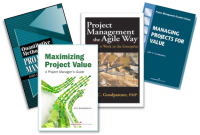
Buy them at any online book retailer!
Tuesday, October 8, 2019

Beware common sense!


This bit comes to us from Neil deGrasse Tyson from his book "Accessory to War"
"What separate great scientists from ordinary scientists ... is the capacity to .... not let common sense dictate or constrain their thinking.

The formidable English physicist Issac Newton, for instance, questioned the the fundamentals of light and color. Who in their right mind would have thought that ordinary light -- white light -- was composed of colors at all?"
In contemporary parlance, this is "thinking outside the box", a meme of behavior and mindset which Tyson might have us believe separates the really good from the only adequate.

Of course, there is a case for "only adequate" which probably describes the bulk of practitioners since the truly gifted and great are out on the tails, as it were. "Only adequate" gets us safe and sturdy, risk averse, tried and true, and free of controversy. The ball does not advance very far, but then it's not supposed to.

On the other hand, "only adequate" isn't going to get you "E = mC2" and all the rest. If you are going to try to convince the world of space-time warp, best to avoid common sense!


Buy them at any online book retailer!

Saturday, October 5, 2019

Percent complete -- Boo!


Perhaps I've said this before. I certainly intended to. But, percent complete is a worthless metric

Not a value measurement:
Percent complete is a ratio. The ratio is dimensionless, whereas value has a dimension; it can be measured.
Percent complete is not only not a measure of value completed; it’s really not even a measure of completeness, even if some things are "completed" at less than 100%.

I say this because, as a ratio, both the denominator and numerator are in play. Thus, “percent complete” is a moving baseline.

What about Agile?
In the Agile space, percent complete is replaced entirely with “remaining effort”. In other words, the Agile management focus is on three questions:

  1. How much do I have to do—to wit: backlog for the iteration, release, or project
  2. How much have I done already—backlog burned and done, and
  3. How much do I have left to do? Note: how much left includes the WIP.

Since the backlog is dynamic—some new things added, some things abandoned, some things left over as debt from prior iterations—you can see that percent complete is meaningless.

The backlog at any given moment is the denominator (burned, WIP, and not started); the numerator is the backlog burned. Both numerator and denominator change from moment to moment, rendering the metric useless for management purposes.


Buy them at any online book retailer!

Wednesday, October 2, 2019

Excel is watching you!


If you've ever managed a project with a really large data set, say the payroll for a bunch of 1099 developers, or the sales records that you're trying to translate and import to a spreadsheet, you may need to watch a couple of important cells to let you know what's really going on:
  • Summary totals; 
  • error codes; 
  • record totals, etc. 
Excel gives the PMO a convenient tool in the Watch Window, found on the tool ribbon with Formulas/Formula Auditing

To use it, just open the watch window by clicking the icon, then click on Add Watch in the Watch Window, and then select some cells.

Thereafter, every time you click on Watch Window in the Formula ribbon, it brings up your list with the latest values. My only irritation with the functionality is that the change is not time tagged. Nonetheless, pretty convenient to use.


Buy them at any online book retailer!

Sunday, September 29, 2019

Your first project as PM


You've done a lot of projects as member of the project team, but you've never been the PM
Now you are one
And your first thought may be: "What do I need to know, and why do I need to know it?"
  • If I gather a bunch of data about what is going on, what do I do with it?
  • Didn't someone say: Don't measure what you are not going to manage?
  • And, very likely, someone said: Don't manage what's not important (or, meant to say: let the self-managing stuff manage itself)
How's it going?
I remember being asked early on: "How's it going?"
And my first thought was: what do you mean?
And, my second thought was: shouldn't I know what is meant by "how's it going"? And, gasp! how do I measure it? (Assuming I knew what "it" is)

Milestones are everything
If it's a big project, you may have an administrator or a team of administrators working schedules.
Yea for them!
Your job is to work value-milestones
  • What are the big chunks of value that need to be ready when
  • No one will long remember the details; but they will remember if you hit the big milestones, rollouts, and put value on the line as promised.
  • Even cost will be forgiven as a tactical necessity if you get the value-milestones right
What to measure and manage
And so, it comes down to barriers, inhibitors, risks, resources etc that will make or break a milestone.
That's the answer you should give to "how's it going" which is really "how's it going to the next milestone?"

Milestones are not self-managing; that's where you job comes in. Figure out what you need to measure to determine if you're going to make it, and then go measure it! From the data, determine a course of action to correct -- or maintain -- the path to success.


Buy them at any online book retailer!

Thursday, September 26, 2019

Talking to not strangers


Here we go again; another of those bits about how to talk and listen. To wit: a conversation!
This one's on TED Talks: "How to have a better conversation".

Naturally, to have a conversation you have to be in the conversation. But with everyone staring at screens all day, and text more popular than talk, it's no small matter to actually have a conversation the old fashioned way: actually paying attention to another person, responding in a two-way conversation.

I heard the TED person say this, which somehow captures the idea:
"You don't need to learn how to pay attention if, in fact, you're paying attention"
Meaning, of course, that paying attention comes naturally if you're actually doing it; and if you're not, it's quite evident to the other person in the conversation.

And, here's another thing: it takes two to converse, but sometimes the least said the better.
Calvin Cooledge (former US President if you're not sure who that is) is quoted:
No man listened himself out of a job
 Meaning, of course, that a conversation where you are saying stupid stuff is probably not the conversation to have, even in text form

And, for the metrics among us, we are told:
The average speaker speaks 250 words per minute, but we are capable of understanding at twice that rate
Question: what are you doing with the whitespace? Mulitasking? Or, as Covey would have us do: listen with the intent of understanding

A good conversationalist is always prepared to be amazed! 


Buy them at any online book retailer!

Monday, September 23, 2019

Value shifting as we speak


I wrote "a" book on project value, "Managing Project Value", though I would like to say I wrote "the" book on project value .... but I won't go there. (See the cover image below)

Now, in that book I assert that "value" is commonly in two flavors:
  • Value as a system of beliefs, " .... are a moral and ethical code of sorts; collectively, they form culture ... "
  • Value as worth, " ...Value is the worth we place upon something for which we are willing to give up something else.  In other words, worth or worthiness has a transactional aspect, and thus we speak of ‘transactional value’ 
Business value begets project value
For decades, business value has been transactional, the ultimate purpose of which is to increase shareholder value in the business.

And so, we get this bit:
We posit that the best way project managers contribute to maximizing value is to deliver a “best value” outcome.

Best value is the most valuable set of outcomes possible for the available investment, risk, and constraints.

Best value is not necessarily best financial benefit; best value can be the best possible outcome of any scorecard metric.

Best value at the project level maximizes value at the business level
But, is all this still true?
Is "maximizing shareholder value" giving way to some other measurement or accountability?
Perhaps
And, can there be accountability without competition, the "Economist" editors ask.
Perhaps not
If not, then away with monopolies!

And to whom should there be accountability and for what?
Is this a new enlightenment?
Maybe the circle is widening; no longer mostly shareholders and shareholder value.
But, as I've written elsewhere, accountability to everyone is tantamount to accountability to no one. So, add carefully to shareholders those to whom you are to be accountable.

Project balance sheet
All then market, cultural, and political dynamics take us back to the project  balance sheet: business value in balance with project outcomes and risk. If one side is to change -- the  value proposition of business -- then so to must the other side.

To wit: stand by for change; stand by for challenges to project culture!


Buy them at any online book retailer!