Saturday, August 20, 2022

Is your PMO worried about 'quantum supremacy'?


What kind of a question is this? 
Is your PMO worried about 'quantum supremacy'?
Actually, some are.

Some of the world's largest banks' IT PMOs are staffing to get answers about how the coming .... but not here yet .... supremacy of quantum computing may affect their projects. And that's to say nothing about comparable PMOs in the law enforcement and intelligence communities, pharmaceuticals, weather, and others.

And before 'supremacy' there comes 'quantum advantage' according to Marco Pistoia, who runs JPMorgan's global technology applied research group. 
  • Quantum advantage means competitive but not overwhelming benefits from quantum computing (Some of this is happening now at Oak Ridge National Laboratory, for instance)
  • Quantum supremacy means overwhelming capability that brings into the frame computing tasks that would never have even been attempted.
What are the issues for PMOs?
For purposes of discussion, they break down into three broad areas:
  1. Threats
  2. Benefits
  3. Operations
Threats
The threat comes from bad actors who acquire quantum capabilities and seek to break into (by solving the decryption, etc.) secure project or business communications, or to break into secure project databases that might have valuable intellectual property or privacy information, to name just a couple of computing-intensive tasks.

So security, heretofore provided by the awesomeness of the computing task to overcome encryption and other security barriers, won't be enough. Many PMOs have to communicate over broad areas, so physical exposure of sensitive communications and data is inevitable.

Of course, quantum encryption by the bad guys of their own stuff may also threaten conventional means to decrypt their nefarious communications.

Benefits
The benefits are almost self-evident: projects that were stymied or impractical by conventional computing capabilities may come into the frame. There may be new science, perhaps even new physics (gasp!)
And certainly a new level of risk management may become available for the truly hard-to-model and understand risk events.
Security techniques that might have been uneconomical may become attractive. 
Data warehouses may provide some residual or latent value that was hidden behind the lack of capacity and capability of conventional computing. 

Operations
Operations break into three categories:
  1. "Keeping up with the neighbors". If you're a big bank, big pharma, big weather, or big anything you have to keep up with your competitors, if not beat them. So your project office, as a component of your enterprise, needs to keep up as well

  2. "Move to the cloud". It's more likely than not that your quantum computing experience is going to be cloud based. Such is already in place for some government and educational projects at Oak Ridge in the "quantum computing hub".
    If now you don't understand the cloud as an enterprise computing platform useful in the PMO and the projects generally, now is not too early to get yourself a project based in the cloud and acquire some experience. 

  3. "Staff for expertise". First, you'll need advisors that can keep track of the technology and explain the utility in terms understandable in the PMO. That's where the banks are starting. Then, you're going to need software people who can architect tasks to fit quantum computers, and other software people to write the code and spin the wheels. 
    And, consider strategic partnerships, especially with the early adopters which tend to be in the research universities, national laboratories, and certain other research centers.
And then there's "entanglement"
Entanglement, somewhat pooh poohed by Einstein, is no-lag-time communication between quantum units without wire and wireless. Literally instantaneous, as it were.
And, such was recently demonstrated over a distance of 20 miles! 
Entanglement brings a new dimension to quantum computing, which may be even beyond "supremacy".


Like this blog? You'll like my books also! Buy them at any online book retailer!
 

Tuesday, August 16, 2022

You pay for others to watch you work


There are a lot of collateral and unforeseen outcomes to the pandemic-driven remote workplace. 

One that I certainly did not foresee is the phenomenon, now a for-profit business, of you yourself paying a fee so that others ... strangers for the most part ... can watch you work.

Or perhaps it should be said the other way around: Some people need a social environment in order to work effectively; they need to know that they are being observed, watched, or evaluated. Without such, virtual loneliness sets in; spirit and productivity plunge. 

Our need to be a part of a professional social environment is important. It's tough to be a loner. So, now you can pay to have a crowd around you. And to be effective, it seems these environments need not be teams, not even groups. Minimally, they are just random collections.
And so now it is possible to join --- for a fee --- Zoom groups of strangers who can  observe you as you also observe them, all working asynchronously and independently on various somethings in their professional lives.
And if it pays off, literally, with improved outcomes that are monetized, who can fuss with the ROI, or the process?


Like this blog? You'll like my books also! Buy them at any online book retailer!

Friday, August 12, 2022

Is trust essential? Is the answer obvious?


"They say" that trust is essential to any project team working effectively. To not trust is to layer on ineffective and non-value add efforts at surveillance, double checking, micro-management, etc and so on.

Yet, if there was universally trust everywhere you do business, you would not need nearly all the structure that goes along with people working in groups. But the fact is that projects of any significant scope are organized with hierarchical structure (minimum trust required):
  • Some one is in charge
  • Others "report to ..."
  • Rules are a tool; they can substitute for face-to-face encounters
  • Trust is not really required because 'rules' enforce acceptable behaviors
  • Break the rules, and there are consequences. But, the consequences are usually time-limited. You get out of the dog house after you've served your time

Not so fast!

Hierarchies may be the on-paper way of organizing, but 'getting things done' requires networks; and networks are definitely not hierarchical. 

But networks run on trust, not rules. No trust ... no network, or least no network membership.

  • Oh, yes, there are consequences, but, no, there are no time limits. 
  • You may be in the dog house a very long time.

 And so here we are:

  • On paper: hierarchies and no trust required. Rules are all that is needed; and consequences if the rules are broken
  • In fact: networks are how people work; rules aren't need. But, if trust is broken, there are consequences. And those consequences are very long term.  


Like this blog? You'll like my books also! Buy them at any online book retailer!

Density of value


Density, if you're wondering, is always a ratio of "something" per unit of "something else". 
You probably recognize such a construction as a ratio. 

Value is a more complicated idea:
  • It's in the eye of the beholder (I value it, even if you don't)
  • It's subject to bias (one in hand vs two in the bush)
  • It's susceptible to the effects of utility compression (more is better, until it's not)
  • It's what you're willing to pay for (willingness and capacity and capability are different ideas)
  • It advantages cybernetics (the outcome is more valuable than the collection of inputs)
  • It's usually 'most bang for the dollar', not necessarily lowest price. To wit: "best value"
  • It may have a wholly social dimension, as value in the public sector, which may be completely subjective
  • It may combine, or entangle, with the closely related concepts of "quality"   
  • It's a lot of different stuff, all at once
Connect the dots: if density is a ratio (it is) and value is a lot of different stuff, what then is the combo: "the density of value"?

Like value itself, there's more than one idea:
  • Pack it all in: How many different things, each separately valuable, can be packed into one container, device, or app, to wit: valuable 'items' per 'container' 

    The smart phone is the poster child for this one: phone, camera, scanner, database, browser, network connector, mobile operating system, myriad apps, compass, geolocator, clock, timer, and endlessly more it seems

  • Compress it by transforming it
    Though vinyl is coming back a bit, cubic mountains of vinyl are obsolete, but the music plays on digitally, but in a lot less real estate

    I still buy printer paper, but a lot less! I 'print' to pdf and electronically store it (and retrieve  it) more efficiently and more densely (hundreds of searchable pdf's on my smart phone rather than file cabinets full)

    My smart phone is no longer a 5-pound brick
    From vacuum tubes, to transistors, to dual-inline, to integrated circuits, I can build an amplifier on the head of a pin; everything needed is just denser!

    From millions of miles of telephone cable, to microwave telephone relays, to microwave cellular, the density of calls per unit of bandwidth is dramatically more.

    And the information density in a communication channel is approaching the Shannon limit of irreducible entropy. To wit: Transfer the entropy elsewhere! Claude Shannon would be pleased no doubt that so many are working on that very idea.
The question
As you create value, are you creating world class value density?!
Because 'value density' itself is valued!


Like this blog? You'll like my books also! Buy them at any online book retailer!

Monday, August 8, 2022

The asymmetry of value


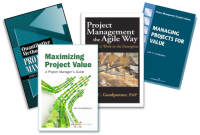
I've written a couple of books on project value; you can see the book covers at the end of this blog.
One of my themes in these books is a version of cybernetics:
Projects are transformative of disparate inputs into something of greater value. More than a transfer function, projects fundamentally alter the collective value of resources in a cybernetics way: the value of the output is all but undiscernible from an examination of inputs

But this posting is about asymmetry. Asymmetry is a different idea than cybernetics

"Value" is highly asymmetrical in many instances, without engaging cybernetics. One example cited by Steven Pinker is this:

Your refrigerator needs repair. $500 is the estimate. You groan with despair, but you pay the bill and the refrigerator is restored. But would you take $500 in cash in lieu of refrigeration? I don't know anyone who would value $500 in cash over doing without refrigeration for a $500 repair.

Of course there is the 'availability' bias that is also value asymmetrical:

"One in hand is worth two in the bush"

And there is the time displacement asymmetry:

The time-value of money; present value is often more attractive than a larger future value. The difference between them is the discount for future risk and deferred utility.
Let's not forget there is the "utility" of value:
$5 is worth much less to a person with $100 in their pocket than it is to a person with only $10

How valuable?
So when someone asks you "how valuable is your project", your answer is ...... ?


Like this blog? You'll like my books also! Buy them at any online book retailer!

Thursday, August 4, 2022

Detecting deep-fake video calls


As I previously posted, there is a growing threat that the person to whom you are video conferencing is really a deep fake. For projects, this threat arises in recruiting strangers remotely by video call, but also in other situations when the 'familiar face' is really fake. (But I know that person! How could the image I'm seeing be fake?)

Here is a report of new research by NSA and UC Berkley about a new tool -- 'monitor illumination' -- that can 'fake the fakes' in a way that gives better assurance that the fake is detected.

Of course, now that this has been widely published, the counter-counter-measures are probably already on the drawing board, so to speak.


Like this blog? You'll like my books also! Buy them at any online book retailer!

Saturday, July 30, 2022

The 2nd Law ....


Did you heat a cup of coffee in the office microwave, and then walk away and leave it there?
Sometimes you just forget.
And when you returned to get the cup, what did you find?
Crap! The coffee is cool again. In fact, the average temperature of all the elements in the microwave are about the same: the coffee, cup, and surrounding air. Whereas after first heating, the averages were quite distinctively different; the coffee was hot; the air was not so much. But after a bit, all discriminating differences are lost. 

Said another way: Over time, and in isolation, "waste" increased, where, in this case, "waste" is the heat (energy) that was usefully in the coffee, but is now wastefully distributed throughout the microwave. The former distinctly organized sources of energy have become homogenous, bland, without contrast and shades of complexion. In effect: disorganized and wasteful; almost without value.

What's happened?
Physics took over.
Yes but ..... Actually statistics is the underlying explanation for the increase in waste, and that idea will take us to project management (which constantly opposes waste)

So read on; I'll get to project management shortly. 

So, what do we make of this?
At the outset, there was order, structure, and organization to the energy in the container. 
But over time, this orderly organization disappeared.

Inexorably, over time, and in isolation (that is: no outside influences or help), "disorder" (as opposite of "order") always increases until some equilibrium is reached. Distinctive differences degrade, becoming homogeneous.

And, by the way, value is lost .... The utility of the disordered is usually less than the ordered. Keep that in mind, project people!

Don't forget the living:
And this phenomenon applies to biological sources also: Without some stimulus from time to time, when in isolation, biological systems all tend toward a low-energy minimum maintenance state.

Statistical formulation
I mentioned statistics.
Hardly was the ink dry on the thermodynamics explanation of the cooling coffee than others grasped the idea that there's a statistical explanation as well: 
The probability of a well ordered configuration is hugely less than a disordered one. Even for the coffee cup situation, there are very few ordered configurations; there are effectively infinite disordered configurations for the distribution of energy. 
Disorder is the more likely end-state.
Generally speaking, given isolation, the probability that disorder increases and order decreases is very high. 
And never the other way around!

The 2nd Law:
All of the above is a layman's explanation of the 2nd Law of Thermodynamics (*), originally conceived as a law of physics to explain the distribution (and redistribution) of energetic molecules in a container. 

But given that there are many more useful concepts that arise from the statistics of disorder, perhaps the 2nd Law should be the Disorder Law.(**)
 
Maximize throughput ... project objective 
Another interesting tidbit, arising from the statistical interpretation, is that it is improbable for a system to be completely disordered or completely ordered. 
The 2nd Law predicts that statistically -- as things are approached asymptotically -- there will always be something missing; something lost; something wasted. 

Minimizing waste and lost value, and maximizing throughput thus becomes an exercise in working with the 2nd Law.


Isolated projects
You probably saw this bit coming: 
Projects that are highly isolated by security protocols, or physical remoteness, or by uninterest and lack of attention are vulnerable to the inevitability of  the 2nd Law. 

If external stimulus, energy, and interest are cut off, then the 2nd Law predicts blandness; lack of innovation, productivity, and morale; an increase of waste; and a general race to the bottom where a minimum effort is maintained. 
And, by the way, who among us have not seen such in the corners of large bureaucracies, oversized project offices, and similar locations? We're likely to say: Does anyone care?
.
Counter measures:
The only avoidance tactic for this decay into mediocrity and blandness is to selectively apply new energy from the outside. 
  • In project terms, this means re-energizing individuals, individually. (Giving everybody a new T-shirt or coffee cup won't restore individual leadership, energy, and innovativeness). 
  • This means aggressively combating wastefulness, non-value add activity, and a general acceptance of 'shit happens'
  • This means allocating time and space, away from the project, for recharging.
  • This means that selective (and genuine) attention to the project by outsiders is mandatory.
  • And, this may require rotation to an outside activity to spark new behaviors.
  • Not least: mitigating some physical remoteness and isolation.


(*) There is a First Law: Energy is never destroyed; it may change form, but in total it is conserved. This is a handy bit of information, but for PM purposes the way in which energy distributes itself is where the action is; and that is the domain of the 2nd Law.

"Entropy" is the word physicists use for "disorder"
 
And, there is a Third Law: The 3rd Law says that there is actually a limit to how disorderly things can become. That's actually good news for PM! But this limit is so remote that it's of no practical consequence in projects, unless you are trying to squeeze the last bit from an information channel. 

(**) There is more about this topic as it affects human situations in Steve Pinker's book, "Enlightenment Now". Pinker uses the term "Law of Entropy" instead of 2nd Law
 

Like this blog? You'll like my books also! Buy them at any online book retailer!