Thursday, May 21, 2020

Your baseline is crushed


With the pandemic effects on project offices, supply chains, capital funding, customers, and cultural changes (how long before it's the same again?), a lot of projects will shut down ... permanently. Their business case crushed in the effects

Rebaseline in two steps:
  1. Declare the "old" project ended; collect the actuals and variances and record them in the ledger. Collect all the inventory for future use: WIP; finished but not delivered product
  2. Invent a new project; transfer in all the WIP and other inventory. Start a new plan with the checklist below
Inventing a new baseline
  • Forget your baseline ... that's all in the history file. Plan a restart as if new
  • Plan for a go-forward velocity that is going to be slower, slogging through a myriad of restrictions, broken links, missing supplies, etc
  • Plan to spend on technology that you probably didn't think you needed before, but you do now
  • Re-calibrate customer needs and wants, functions, features, convenience, safety, security (how did Zoom zoom into our lives?)
  • Can you visit your customer? Should you visit you customer? Is a virtual visit good enough to understand the requirements?
  • Factor in the changed culture .... some values have changed for what you're inventing, I'll bet
  • Evaluate risks with a revised calibration .... where does social fear factor in? 
  • Plan for a medical protocol overlay. Masks, social distancing etc?
What could possibly go wrong?!


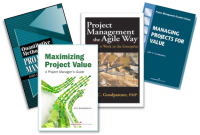
Buy them at any online book retailer!

Monday, May 18, 2020

Saying it visually


Visual communications, or communicating visually, are all the more important as the virtual workplace becomes the "new normal". There's a skill to be learned for effective communications with visual as the centerpiece.

Got these needs?
  • Proposal
  • Message
  • ESL audience
  • Virtual meeting?
Then this Khan Academy series on visual language is a place to start.
There's power in framing, stretching, shaping .... not to mention color, contrast, shading.


Buy them at any online book retailer!

Friday, May 15, 2020

The biases come out


Under stress, the biases come out
Not only do the risks change, but risk attitudes change as well
The stakes may be higher; the consequences greater.

Now is the time to revisit the best book ever written on risk management -- in my opinion


"Against the Gods, The remarkable story of Risk" by Peter L. Bernstein is an excellent read and ambitious premise well delivered.

Perhaps the best general history of risk -- and presentation of the major concepts of risk -- that is understandable by all practitioners at any level.

The content is presented in a general historical order in major sections by epoch. The first being from the ancients to 1200, then the middle ages and Renaissance. Finally, then into the industrial revolution, and modern era.

Along the way, Bernstein recounts not only the emerging understanding of risk per se, but also the allied concepts of counting, numbers, chance, and of course, business management.

No math! (Almost no math)
There is not much math or statistics to trip up the qualitative mind! (Yea for that) But, the presentation of the evolution of our understanding of chance introduces many of the main characters and demonstrates their contributions with just enough math/quantitative examples to make it interesting.

Mystical and Divine... pressing on!
Much of this material describes the period 1700 - 1900 when much of the modern underpinnings of chance, probability, and statistics were developed and made understandable to the general business population. We learn, for instance, that it was in this period that the notion of risk in the modern sense emerged from the mystical and divine to the cause-effect concept.

While the parallel developments of mathematics, business practises--like insurance--and a math/cause-effect foundation for risk are presented with a storyteller's gift, I found Bernstein's recounting of the ideas that developed after 1900 to be the most interesting and insightful.

Along comes the psychologists
Of course, the story in this book ends just about the time that the ideas of Amos Trversky and Daniel Kahneman, first developed in the 1970's, are gaining popular acclaim in the 90's. Thus, in this part of the book we get a great explanation of the expansion of utility theory first developed in the 1700's but advanced into Prospect Theory by Tversky and Kahneman.

There is also excellent explanations of various biases and other cognitive maladies that intrude on the rational and objective. We learn a good deal about the failure of invariance--the idea that same manager can be risk averse and risk seeking depending on not only the point of view presented (glass half full/half empty) but also whether there is a sure loss or a sure win at stake.

Someone else likes it
Bernstein's expertise is in the financial world. John Kenneth Galbraith wrote of "Against the Gods": "Nothing like it will come out of the financial world this year or ever. I speak carefully; no one should miss it".


Buy them at any online book retailer!
Tuesday, May 12, 2020

Shut down, start up


There's a lot of this stuff going around: "Shut down, start up".

You get a "stop work" order; if you're a government contractor, you may have strict protocols to follow, or worse, you may have a lot of expenses to secure the project for which there is no immediate cash flow.
  • Select a skeleton staff for the shut-down work
  • Work with HR to furlough the redundant staff; ditto "security" if there are cleared people involved
  • Figure out the physical and electronic security for the partial product and inventory
  • Some stuff may have a shelf-life. Who is to run the maintenance on that?
  • Who has the ownership or title to the intellectual property? You may need some legal help to secure the project's IP
  • Set up an archive for project records; assume the original staff may not return, so where is everything to be found?
  • Set up billing codes in the chart of accounts for the shut-down work
  • Bill-out whatever you can; some stuff may not be billable overhead and may come off the bottom line.
And then you get a "restart work" order. But, restart with whom, how, where?
  • Is the business case still valid? Is there a modified business case going forward? Revisiting customers and business sponsors should be on your list
  • Green field staffing? You may want to reorganize the staffing, not rehire everyone, and recruit for others. Is there an HR policy issue here? Perhaps you don't have the flexibility to restaff from a green field.
  • Green cards: are they still around? No? What now?
  • Incentives? Some may require an incentive to return. Where does that fit into policy and finance?
  • Where to set up shop? Your project space may no longer be available; maybe the building has been shuttered
  • Restart virtually? Do it with a "gig" staff? How do you cover the cost of 'gig' turnover?
  • IP? How will you redistribute the intellectual property of the project? Indeed, do you even have a clear title to the IP? Did some of it walk out with the shut-down?
  • Cost-schedule-scope: And, with the experience base changed, the baseline going forward will be different. Costs and schedules will be different.
This stuff is hard!


Buy them at any online book retailer!

Saturday, May 9, 2020

Virtual conferencing ... a lot in the market


Yikes: the products and services for virtual conferencing and teamwork are jumping out of the woodwork:
  • Here's a nice comparison of Zoom and Blue Jeans
  • Microsoft TEAMS which is integrated with Office 365 now has a home version as well
  • And, of course, there are the established WebEX, Skype, etc
  • Google is not to be left out, nor is Slack
Here's a collection of 10 articles on collaboration tools with a number of feature comparisons


Buy them at any online book retailer!

Wednesday, May 6, 2020

Re-starting costs


Re-starting (aka reopening) a project comes at a cost
Who pays?

It depends ....

There are these major cost elements to consider:
  1. Re-hiring, replacing, and/or retraining staff
  2. Reconstituting the supply chain: termination costs for contracts that are null; solicitation costs to replace terminated or non-operative contracts and source new materials or services
  3. Restructuring the workplace to comply with new safety protocols
  4. Planning for outcomes not normally expected: excessive staff turnover and absence; unscheduled stops and starts; unexpected defaults
  5. Mixing in more redundancy and inefficiency to increase project anti-fragilism
If the original business case didn't have much cost-benefit margin, these costs could swamp the benefits, making the project a business loser .... thus, RIP

A restructured business case
A restructured business case -- with the restart costs factored in -- might be the answer to a project rescue.
Although harsh, a restructured business case might include some housekeeping that is long overdue.

And, a restructured business case might attract new investors with a different risk attitude.
It might be possible to not only improve the balance sheet in the short term, but establish a business cash flow that's eventually favorable when viewed through a different risk-attitude lens.

Bottom line: Good luck!


Buy them at any online book retailer!

Sunday, May 3, 2020

Fission and Fusion


In the book "Unbound", author Richard Currier, has described group behaviors as fission-like -- meaning the group members move apart -- and fusion-like -- meaning the group members coalesce together.

And, he says, fission-fusion tendencies coexist in the same groups somewhat continuously.
Now, until quite recently, in the context of the PMO:
  • Disparate team members "fused" at the office to form cooperating work groups
  • And then, at the end of the work, they 'fissioned': moved apart to return to their "other life"
Indeed, teamwork (day job) and 'other life' couldn't happen if not for instincts for both collective and private time. Currier writes:
Human society as we know it would not exist were it not for the innate primate passion for group identity and solidarity combined with the flexibility of the fission-fusion society.

Our instinct for group identity allows us to form groups with enough coherence to stick together with a feeling of solidarity and to work together to achieve common goals.

Our instinct for both fissioning and fusing allows many groups to proliferate within a single society, each defined in a different way, and each meeting a different set of social needs 
But now we may be moving to a new normal: 'social distancing' on an industrial scale, at least until the fear subsides and the medical remedies are in place.

Consequently, whereas in the last ten years or so we've called project members back in from home to work more closely ... thereby to harvest the informal interaction that can be the seed of innovation ...  now we may be more about fission than fusion.

Indeed, Currier again (substitute 'project' and some number that corresponds to your project):
Modern nations and political movements include thousands or millions of members, most of whom have never met and never will meet, yet they collectively identify themselves as belonging to the same group and living within a single circle of trust. 
"... Never met, and never will meet ..." that's profound for a PMO
A new normal?


Buy them at any online book retailer!