Saturday, October 30, 2021

Supply chain scheduling


What can I say here that you've not heard before?

First: we are living in a time of scarcity, and so strategies for allocating scarcity come to the fore.

Second, demand for the scarce drives price -- no news there -- but demand itself may color supply and thereby schedule. Supply will not be directly correlated with price. Why? Because supply is what is going to be allocated, and price in dollars may not be currency. The currency of supply may take these forms: 
  • allocation may bring loyalty into the mix; 
  • may bring commitment to very long term relationships as the price of access
  • may favor the cash deal over credit
  • may require large up-front down payments that didn't exist before 
  • may require quid pro quo: you have something I want; but I have something you want
Scheduling the scarce
So, now your job is to schedule in the context of such a landscape.
You begin with the normal risk tolerant scheduling techniques like those explained in "Critical Chain" theory:
  • Be sure you understand that the 'most important schedule path' may not be -- technically -- the critical path. 'Most important' is where the critical value is as viewed by the customer or sponsor.
  • Protect the 'most important' path by allocating what resources to that path first, and starving, if necessary, others
  • Generously buffer around all the key milestones so that none are 'fragile' in the sense of bringing down the project if the nominal target date is missed
Architecture may help
Your architect can help you by designing-in all the anti-fragile strategies so that a missing part or resource, or a  sub-optimum substitute, is not fatal or cause a chaotic outcome. Your job is then to schedule these strategies into the master plan.
  • Redundancy
  • Negative feedback for stabilization
  • 'Rip-stop' interfaces between subsystems, objects, and other elements
Your CFO may help
  • Cash is king when demand exceeds supply
  • Long-term contracts with favorable financial incentives may free up supply
Your take away:
Scheduling with scarcity is not just an exercise in time management. All the other disciplines can play a part.


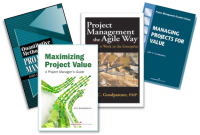
Buy them at any online book retailer!
Sunday, October 3, 2021

Just what we need: another reorganization!


"Whether in government or private business, office reorganizations are invariably touted as efficiency moves, when just as invariably—as anyone who has experienced one can attest—their short-term effects are redundancy and paralysis.

Naturally, the extent of these ill effects correlates to the amount of thought and planning—or lack"

Scott Anderson “The Quiet Americans".

What to do?
As a practical matter, PMO should reflect this experienced voice in project plans by planning for an initial dip in productivity, increased waste (likely increased cost) over the short term, and an extended schedule to allow this all to unfold.

To manage the risk, buffer all the critical tasks and milestones, and assume some less-than-expected performance in the short-term.

All this to give time for new relationships to form, new processes to be practiced and debugged, and for a steady-state to form and become apparent. 

And, of course, some stuff won't actually work; so some adjustment of the reorganization is to be expected, but perhaps only after a good shake-down period.


Buy them at any online book retailer!

Wednesday, September 29, 2021

Classified projects --


Most of my career has been working in the black and grey world of classified projects. 
If that is your domain, heed these words:
It is the nature of classified projects that "successes are unheralded and .... failures are trumpeted"

JFK

So, if you have an idea of putting your successes on your resume, looking for your next job, gig, or career move, beware!


Buy them at any online book retailer!

Saturday, September 25, 2021

Virtual collaboration: a comment


" ....virtual collaboration is like evaporated milk with 60% of the water removed; safer; mostly up to the job, but a sterile version of face-to-face that leaves an unsatisfying aftertaste"

"Bartelby" columnist in the "Economist"

Our columnist goes on:

"There are downsides to being a clinically efficient worker. They include relinquishing the daily banter and complicity among colleagues..... Hyper efficiency and distance mean less opportunity for interpersonal tension but also less gratuitous job, which is hard to replicate on Zoom."

But then, on a business channel, I hear a start-up guy talking about developing a software application (alternative to Zoom, or Skype, or Webex) that has 'humanity built-in' 

"Humanity built in"! Perhaps, but let's wait and see ....


Buy them at any online book retailer!

Tuesday, September 21, 2021

Ghost writer and communicator


So, you work in project communications, perhaps directly for the PM. 
Great job, and it can be a lot of fun being creative.

In the 'old days', that probably meant long-form press releases and updates to the project web page or communications dashboard.

Today, it's those plus social media; scripts and plans for podcasts and videos; and other duties as assigned (ODAS)

But, if you're a ghost writer for the 'boss', who gets the credit? Do you have a byline as a contributor? And, does the boss get the credit for imaginative and effective writing or production when it's really you?

Welcome to the world of ghost writing. 
The person you're writing for gets the credit, usually, and you're lucky if you're recognized outside your PMO. You probably knew all that coming into the job. Why else is it called 'ghost' writing?
 
But what if you disagree in some fundamental way with the content of the communication you've been asked to write or produce? What then?

Two cases:
  1. Opinion: It's not your opinion you're opining. You can write 'B' for the public, but believe 'A' privately.
  2. False facts: If not about 'beliefs' but rather about misleading or even factually incorrect material, you have an obligation to push back. 

Life is too short

If you can't live with the material you're writing, then don't. Find new material; and find a way to persuade the boss to let you use it.

And if all that doesn't work, you may have to fire the boss! (Aka: get a new job)


Buy them at any online book retailer!

Friday, September 17, 2021

Projects and capitalism


'Capitalism' is in the news. And, not for the first time we're hearing about how corporations have an obligation more reaching than just the traditional shareholder value -- meaning profit maximization.

Community impact is now in the mix, more so than in the past, and that may mean capitalism will be paying attention to multiple factors beyond profit maximization:
  • Environment -- a steady standby, to be sure
  • Diversified workforce -- at least as diversified as the local community
  • Job stability -- meaning, careful about robotics displacing workers
  • Job location -- meaning, careful about remote working, virtual teams, and the lot
  • Educational opportunity -- perhaps a mentorship with the local intern program or university
  • Social justice -- meaning a safe workplace, and support for social justice in the community
Regardless of whether you think business should take these on, you probably think that these are 'C-Suite" issues -- isn't that what we pay them the big bucks for?

Not so fast!
There is flow-down to consider. Since at least 1992 -- ancient history for many of you -- the "Balanced Scorecard" has been a feature of business score keeping. And with it, a deconstruction and flow-down of corporate goals throughout the business.

And so, we can anticipate that such will reach to the PMO. 

Cost-Schedule-Scope-Quality
Wait! In the PMO, our thing is cost-schedule-scope-quality. Where do we fit that other stuff in?
  • First effect: Scope -- some of these things will inevitably get cranked into our scope statement. Fair enough. But, scope connects to cost and schedule ..... don't forget that!
  • Second effect: Cost -- it takes money to do some of these community things.
  • Third effect: Velocity, meaning rate of throughput, meaning: schedule. No doubt some of these community things are going to slow us down .... but, perhaps a trade worth making.
Measuring the PMO
At the end of the day, project metrics should -- and will -- reflect this larger landscape. 
 
As examples of how such capitalism objectives might flow down to the PMO, maybe we don't remote as much as we could and keep a more robust local presence. Such will increase velocity because bandwidth has been added to team interactions and communications, and cost may be reduced a bit because remoteness is not free
 
Maybe we adjust the supply chain to be locally more than we need to -- in effect: buy local.
 
Maybe we hire less experienced but local people and invest in their development. Such may adversely effect velocity and cost in the short run but pay community benefits in the long run.

Steady on! Maybe we need a business culture from the C-suite that supports all this!


Buy them at any online book retailer!

Monday, September 13, 2021

The Incompetence Dodge


There are so many 'laws' that govern Project Management one wonders how to keep track of them all.
Now comes "The Incompetence Dodge", originally formulated by Sam Rosenfeld and Matt Yglesias. Their domain was foreign policy, but their idea can be recast to project management.

Simply put: if your idea failed, you need not look to the quality of the idea; you simply blame others for implementing your idea incompetently. 

Simple tactics, and the dodge
With such a simple tactic, any errors of strategy on your part are transferrable to others as errors of tactics!
Thus, you dodge around bad ideas by the ruse of incompetence by others.

How long can this go on?
How long? It depends on whether you are in charge of the time or the clocks.
If you've got time on your side, you can run out the clock, maintaining the dodge forever.

And, here's the really good part: you don't need jump on incompetence right away. You can wait and see which way it goes. 
  • If your bad idea is somehow rescued by brilliant execution, you can claim victory. 
  • But, if it goes awry, you can jump on incompetence and avoid personal defeat!

Bottom line: you can be blameless!


Buy them at any online book retailer!