Sunday, July 12, 2020

Ruts vs grooves


Are you "in the groove", making good time and product, or are you in a rut?
How to tell?
  • A rut is about 6" deeper than a groove
  • It's easy to see over to the next groove -- it may be better -- and you can change grooves if you need to
  • In a rut, you often can't see out for other opportunities
  • A rut sometimes just gets deeper the more you're doing
Alex Walton, 3PM
In a rut, the first rule of holes often applies: just stop digging!

Beyond platitudes:
Most people would prefer not to be in a rut; it's not stimulating and rewarding
  • Like never before, self-help is the first step out. And the internet is the primo source of self-help.
  • Summoning the courage to take a risk is probably step two. Even if you're just moving into a groove in familiar space, that sometimes requires some risk-taking
  • Asking others for an evaluation of your profile is an important risk step. Park your ego and your pride long enough to take in the data and process it.
  • You may have to outright quit and start over, maybe even entry level. Or, if you're entrepreneurial (and everyone isn't), you can start your own 
But the most important thing is to overcome inertia and "do something". If it doesn't work, try again. Ruts are not permanent.


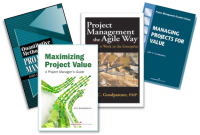
Buy them at any online book retailer!

Thursday, July 9, 2020

What flavor is your scope creep?


Can there be scope creep in Agile? 
Doesn't agile define creep away in a stroke: "Scope is whatever is prioritized in the backlog that fits within the budget (OPM, other people's money) and the time."

"The backlog changes all the time, but that's not creep, it's just backlog management."

What I just wrote is a "best value" definition of scope. But, sometimes it just doesn't sell.

I credit my agile students with these observations about "creep", to wit:

Project scope creep: it may be well and good that a true pure play on agile has no conception of scope creep, because the backlog is simply rebuilt as a zero-base-backlog (ZBB) after every iteration -- if not after each iteration, then certainly after every release.

Consequently, after every release, you should be able to stop and be satisfied that you've delivered the best possible stack of high value objects. Amen!

Resource scope creep
On the other hand, if you can't get commitment for dedicated teams because the resources are needed elsewhere, then you are saddled with the overhead and inefficiency of rolling out and rolling in resources. This is resource scope creep -- spending more on resources' training, recruiting, and assimilation than the budget allows.

Clearly, this is a different flavor than project scope creep.

And, it's been around since forever!
Who's not heard of "resource plug-and-play"?
The plug-and-play process: just define a role, line up the role with appropriate resumes, pick one, plug them in, and you're off to the races!

  • For more on plug-and-play, see the work of F.W. Taylor and "management science" wikipedia.org/wiki/F._W._Taylor

Agile to the rescue!
The fix is in: a pure play in agile means having fully dedicated teams that use the inevitable white space in the team schedule to improve the product -- more testing, more refined refactoring, working completely through the technical debt -- but not to get off the team and go elsewhere, only to return later.

Ooops!
The idea of giving up on matrix and other plug-'n-play resource schemes is pretty much opposed by managers not willing to give real agile a try.

Shifting from input to output
Again, it's an input/output focus tension... managing the white space by moving resources around is an input focus; leaving resources in place to use the white space for quality is an output focus.

Traditional schemes often put resource managers in charge of finding resources for the project manager. Obviously, those resource guys are going to focus on getting their job done according to their metrics.

Agile schemes are a bit different: once the resource manager has given up the resource to an agile team, it's the team leader who's


Buy them at any online book retailer!
Monday, July 6, 2020

Hiring for skills


The thesis is simple enough: when you need a job done, hire a skillful person [setting aside, for the moment: robots]
Who's not referred to Angie's List from time to time to find a plumber?

Bachelor's hegemony
But in the project business, there has been for a long time the hegemony of the bachelor's degree ... which is not to be denigrated in any way (I've got one) .... but there are alternatives.

Let's hear it for skills
And so the "skills development" industry has gone into high gear .... shifting now to mostly online ... with much corporate help [Microsoft, among many others] to make it possible for millions who have lost retail and hospitality jobs to move in the direction of filling the pre-pandemic 12M openings for alternatively skilled staff, usually at a higher compensation.

Now, ours is a business that has put emphasis on either/and a bachelor's degree or a PM credential from PMI or others. Our local university has a very robust program in project management that is available to the public.

But there's no reason that for the myriad of project jobs -- not necessarily the PMO -- that the hiring principle should not be 'skills-first'.

What do you get?
  • Usually bootstrappers who've shown personal initiative and have got other work and life experience; they appreciate the opportunity to dig into a good opportunity
  • Not too much baggage that requires re-training. In many cases it's a green field for both culture and job-specific skills
  • Opportunity to be a 'good corporate citizen' for the local community
  • A few that can't make it in your context .... HR issues around tenure, etc


Buy them at any online book retailer!

Thursday, July 2, 2020

Good writing, and a well-chosen word


What does one learn when reading great ..... writings? That well-chosen words are the way by which past deeds acquire meaning and future deeds acquire purpose.

“The world will little note, nor long remember what we say here,” are the only false notes in the Gettysburg Address. The Battle of Gettysburg is etched in national memory less for its military significance than because Lincoln reinvented the goals of the Civil War in that speech — and, in doing so, reimagined the possibilities .....

[Great] writing doesn’t just provide meaning and purpose. It also offers determination, hope and instruction.
Bret Stephens
Now, I think it's reasonable to say that most writing coming forth from the PMO doesn't rise to the level of the Gettysburg Address in eloquence or conciseness, or engender the profound effect the Address has had on generations since.

Nonetheless, if the bar is more reasonably set at the level of "good writing" --- clear, concise, unambiguous, and purposeful --- then we should take to heart in all project communications that words do matter, and that choosing the right words should not be a task taken lightly.

I've often said that "good writing is not written, it is re-written", meaning: the first draft is just that: a draft. The published version is -- or should be -- more likely the draft re-written. [See: take a moment before you send that text or email]

But the point here is not so much to lecture about writing well; rather it is to make the point that in executing the first job of the PMO --- to communicate -- the PM should bear in mind the three big steps:
  1. Tell them what you are going tell them
  2. Tell them (enter: a well-chosen word)
  3. Tell them what you told them
Said another way:
  1. Establish the background, explain how the past got us here
  2. Lay out the task ahead
  3. Connect the dots to future goals
 "That well-chosen words are the way by which past deeds acquire meaning and future deeds acquire purpose"  ..... Well said!


Buy them at any online book retailer!

Monday, June 29, 2020

Out-of-the-office worker-traveler


Following up on my last posting, here's some other insights to the out-of-office worker and traveler, as quoted from the recent press*

[C.E.O. read: project executive]

“A C.E.O. who does not meet people in person is a captive to the aperture of a camera lens rather than the aperture of her eyesight. .... —Bill Perlstein, Washington

• “The office doesn’t matter for the C.E.O. (who travels a lot anyway) or any other executive. What matters is what they accomplish. If you think about it, the office environment is an expensive artificial structure ....”—Joe Carlin, Cary, N.C.

• “As a former director of research ... , the best ideas came from colleagues talking over coffee or at lunch about some pie in the sky idea or discussing a problem they could not solve.” —Emily Jones, Rochester, N.Y.

• “I am an ‘outbound C.E.O.’ That means over 50 percent of my time is spent outside of the office constructing high-value relationships ... An ‘inbound C.E.O.’ spends over 50 percent of their time in the office and builds value by management of the company processes. ”—Steve Baird, Vancouver, Wash.

•  I would say that being on-site was essential. I felt responsible for creating a positive work environment and for maintaining a caring office culture. I don’t see how I could have met those objectives remotely.”—Erica Moeser, Madison, Wisc
--------------
*New York Times, May 28th, 2020


Buy them at any online book retailer!

Friday, June 26, 2020

Maybe you shouldn't work from home


From press clippings we get these bits about not working from home, which I've paraphrased:

What about social capital? 
The relationships currently sustaining business [and project offices] were built from face-to-face meetings before the lockdown. This "capital" that has been banked, to think in Stephen Covey terms, will erode over time if not refreshed. The longer people are apart, the weaker those bonds become.
So, how to build up the bank account will be a topic for the near future.

Remote hiring:

How would any new hire acquire the project [or business] culture; how would they made to feel connected? How do you do remote mentoring?

Of course, virtual teams have been dealing with this problem for years, so many protocols are already well developed for the new-but-remote person on the team

And, what about personal goals? 
Some predict a potentially destabilizing divide between workers who get ahead by going into the office and those who work remotely and miss out on career opportunities. “Everyone who wants to manage, to run things, to influence, to jockey, to make friends, to build a network — they will clamor to work in the office,” David Pogue writes. “Almost every single ambitious person in a company will be demanding a desk at HQ.”

I agree: when I worked for the military in Berlin, it was all about who could get closest to the flagpole.

What about the power relationships?

Like it or not, proximity to power is important, so if a project executive promotes a remote-first approach but then works mostly in the office, what's the power message there? And, ref to the above, who stays home while others get close?


Buy them at any online book retailer!

Tuesday, June 23, 2020

About ignorance


Ordinarily, we don't put much value on ignorance -- or being ignorant.

It's said that in the pre-modern world, say before the enlightenment in Europe in the middle of the first millennium, that all you needed to know was pretty much what could be learned from history.

If it wasn't known, then you didn't need to know it, in the same way your forebears didn't know it either.

History is limiting
But, thankfully, we came to understand that history -- if that's all you know -- is quite limiting. The enlightened figured out that there is a case for ignorance -- that is: recognizing you are ignorant of something. And, then setting about with a project to fill in the blanks.

Filling in the blanks
And, you might notice, guys like Newton and daVinci brought the concepts of observations and mathematics into the battle of ignorance. Indeed, for the longest time before, math was considered "philosophy".

And then we have Bayes, somewhat a contemporary of Newton, with his version of continuous improvement: form a hypothesis based on assumed conditions; make observations; then adjust assumptions about conditions to conform to observations.

And so, that's the idea here:
  • Know, going in, that you are likely ignorant
  • Recognize the value of theorizing and observing to overcome ignorance
  • Don't assume history has all the answers -- it doesn't
  • Appreciate that improvement doesn't just come from reorganizing what you know(*); sometimes new facts are more powerful (See: Newton)
  • Repeat 
----------------------------
(*) Pre-Newton methodology which actually carried on in some forms until the industrial revolution


Buy them at any online book retailer!