Wednesday, December 18, 2013

Scope is a fact; value is an opinion


One of the mantras I learned early in my business career is:

"Profit is an opinion; cash is a fact!"

reflecting the fact that there are a lot of non-cash expenses that go into the profit calculation, many of these are informed opinions that interpret the GAAP (Generally accepted accounting principles)
 
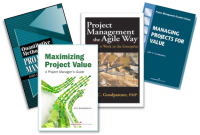
Now, having written the book on maximizing project value*, I feel qualified to advance the parallel idea:
Scope is a fact; value is an opinion!
So, if you are trying to set down some plans, some controls, and some degree of predictability, would you pick on scope or value as your control mechanism? And, would the CFO pick on cash or profit for the project's business case?

Presumably you would go for a control mechanism that is non just an opinion. Who wouldn't?

Not so fast!

Jim Highsmith, an agilist with a new book "Adaptive Project Leadership" tells us (in Chapter 3) that scope is a very poor control mechanism -- but he doesn't say exactly what scope is to control, or why it is poor.

Highsmith does say that a lot of scope that is delivered goes unused and thus does not contribute to business value. Fair enough. We all know that most of us don't/can't use the majority of functions in MS Office!

He idea -- similar to what I say in my book -- is that a better payoff for the business is focus on controlling value -- that which the customer finds useful and important, and for which a customer is willing to pay. Thus, value -- again, a matter of opinion -- should be the control mechanism.

Consequently, we need a way to come to a common opinion. The great leveller is money, and so monetizing value is the default. We see this in the start-up business valuation as well: it's all an opinion as to what the company is/will be worth.

And, as I posit in my book and elsewhere: the value of a project is really the impact it has on the value of the business... and that might take some time to materialize. Thus, history may be the ultimate judge!

* "Maximizing Project Value: A project manager's guide" (See cover image below)

Read about these books I've written in the library at Square Peg Consulting
You can buy them at any online book retailer!
Sunday, December 15, 2013

Safety critical principles


At Critical Uncertainties there is a very good posting of some 21 principles attendant to managing risk and providing for safety in systems where safety criticality is predominant.

Here are a few I picked out that seem to come up often when doing a risk register of unlikely but severe risk events and outcomes.

I add this bit of editorial: the principles lead directly to the so-called "1% Doctrine" that posits that peremptory action is justified to neutralize a risk source, not just mitigate consequences.

The 1% Doctrine is Principle 1 in different words. 

We see this played out in the security arena big time, everything from preempting WMD to preempting travellers at the airport check-points.

But on the project scale we see peremptory action to avoid a project budget cut or resource reassignment. In other words these principles have both strategic and tactical application:

  1. Where risk exists there also exists an ethical duty of decision makers to eliminate if practical or, if it is not, to reduce such risks to an acceptable level.
  2. The greater the potential severity of loss associated with the system the more likely the organisational and societal focus will be on prevention ... rather than mitigation of consequences.
  3. Risk ... is a social construct and can never be evaluated in a totally objective fashion.
  4. Some unknown risks may disclose themselves in the life of the systems, some may never be identified.
  5. The greater the severity of a [risk] the lower the required occurrence rate and the greater the .... uncertainty of estimation of probability.
  6. The greater the .....uncertainty of probability estimates the more the focus should be upon the reduction in the severity of consequences.
  7. The more complex a system the more likely it is that an accident will be due to the unintended and unidentified interaction of components, rather than singular component failures or human errors.
  8. One can never absolutely ‘prove’ the safety of a system as such arguments are inherently inductive.


Check out these books I've written in the library at Square Peg Consulting

Friday, December 13, 2013

Change and Collingridge's dilemma


A simple but profound observation:
When change is easy, the need for it cannot be foreseen; when the need for change is apparent, change has become expensive, difficult and time consuming.
David Collingridge"The Control of Technology"

Check out these books I've written in the library at Square Peg Consulting

Tuesday, December 10, 2013

Necessity drives invention


From one of my agile students:
Traditionally my organization -- a healthcare insurance company -- adopts the waterfall approach, but with the projects related to healthcare reform and participation in the new Health insurance exchanges we had to adopt the Agile methods, especially because lack of clarity in requirements and ever changing rules and regulations from the state and federal government.

Check out these books I've written in the library at Square Peg Consulting

Sunday, December 8, 2013

Fallacies, illogic, and bad arguments


I came across this ebook (free) that is a good, fast read... with humor... about "bad arguments", logic, fallacies, poor reasoning, wrong conclusions, and more....

Recommended to all!

https://bookofbadarguments.com/


Check out these books I've written in the library at Square Peg Consulting

Thursday, December 5, 2013

Shakespeare on risk v opportunity


Shakespeare had some interesting insight to the dilemma of whether to see an event/condition as an opportunity that defines the future, or a risk that we may well regret:
There is a tide in the affairs of men,
Which, taken at the flood, leads on to fortune;
Omitted, all the voyage of their life Is bound in shallows and miseries....
And, we must take the current when it serves,
Or lose our ventures.
William Shakespeare, "Julius Caesar" 

In hindsight, this is a lot easier said than done. Indeed, we may well recognize a flooding tide... who could miss all the boats being lifted? ... but when is the tide at its flood (maximum lift)? That's a hard one to judge in real time as it happens -- perhaps if we wait, the tide will go a little higher! (if it doesn't ebb)

But, the issue is not really about missing the peak... that happens a lot with no catastrophes. The issue is about missing the whole damn tide event.... not taking a risk when opportunity presents itself.

How many projects are too risk averse to really be successful? I'll bet more than you might imagine... or admit to.

Check out these books I've written in the library at Square Peg Consulting

Tuesday, December 3, 2013

Project Histories..


"The young Alexander conquered India
On his own?

Caesar defeated the Gauls.
Did he not even have a cook with him?
Excerpt from Bertolt Brecht's poem: "Fragen eines lesenden Arbeiters"

When the campfire stories of your past projects are told, who will get the credit? It never hurts to give credit to the little people, the staff, and the technicians that helped make it happen.


Check out these books I've written in the library at Square Peg Consulting