Wednesday, March 13, 2013

Just published!


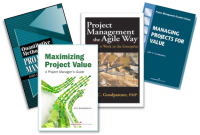
My latest book -- "Maximizing project value: a project manager's guide" has just been published. You can get it at any online retailer in paper; it's also in KINDLE form and google eBooks.

LOOK INSIDE at Amazon or google/books


Check out these books in the library at Square Peg Consulting

Monday, March 11, 2013

Tech debt explained


Philippe Kruchten gave an interview on techdebt.org about his idea of what technical debt is (and is not, or should be restricted to be)

He explains things (read the whole interview) using this image:


His thinking is that the term "tech debt" has become so much of an industry meme that it's lost its intended focus. For his money, the stuff in the box is the stuff that ought to be in the technical debt backlog.

And, by the way, that's another issue: too often the backlog is just the customer facing stuff; that way under states what a real project takes. Not only the non-functional stuff needs to be integrated into the backlog and resourced, but so also the technical debt, and the other stuff, as yet un-coined, that's outside the box.

About Philippe Krutchen:
Philippe Kruchten is a professor of software engineering in the department of electrical and computer engineering of the University of British Columbia, in Vancouver, Canada. He joined UBC in 2004 after a 30+ year career in industry, where he worked mostly in with large software-intensive systems design, in the domains of telecommunication, defense, aerospace and transportation.

Saturday, March 9, 2013

About mistakes


Some say that an enlightened business/agency/enterprise is one that provides the freedom to make mistakes. Recently, Quantmleap had a posting on this very topic.

Perhaps... But, I don't agree with the broad idea that we need to allow for and accept mistakes. Mistakes are only tolerated up to some point, then ....

OPM
If you're working your own money, then you're free to make mistakes. But, if you're working with other people's money (OPM) it's all together a different situation.

Take a risk
This idea about mistakes should be more narrowly drawn, to wit: we need the latitude to take risks --some of which may not work out -- that are within the risk tolerance of the enterprise. How do we know what the tolerance limits are? We can ask, or by experience and intuition we learn/know the boundaries.

Here's the tricky part: risk attitude is not stationary: it matters when you look at it. Over time, optimism abates; pessimism rises. And, prospect theory tells us that risk attitude is different if you are facing a choice between bad or worse or between good or better.

So, it matters when the mistake is made (temporal dependency) and matters whether or not a mistake was made trying to avoid a really bad outcome (utility dependency)

We also need the latitude to make tactical errors (mistakes in some cases or calculated risks in others) so long as we don't make a strategic error. That is, we can be wrong tactically so long as we can recover and get back on a track toward the strategic objective. But to make a mistake on the strategic objective is almost always fatal.

Causality
We should also be mindful that -- even with the latitude allowed for these classes of mistakes or errors in assessment or even judgment or risks gone bad -- the cause or causality of the mistake is material. Negligence will never be tolerated; so also duplicity, though innocent ignorance may be ok.  Thus, the same mistake (effect) with different cause may be tolerable, or even thought to be a good bet that didn't work out.

Absolute?
Consequently, as in all 'rights', the right to make a mistake is not absolute;  as a practical matter there are often many constraints to even a liberal degree of latitude.

Geithner on mistakes


You are going to make mistakes so you have to force yourself to decide which mistakes are easier to clean up.... In a crisis you get to a point where you have to decide that you're going to risk doing too much because it's easier to clean that up

Tim Geithner
US Secretary of Treasury
19 Jan 2013

Thursday, March 7, 2013

Vision, mechanics, moment

A whole lot has been written about great leaders who can move their constituencies and really get things done. For me, Jon Meacham summed it up recently by positing three elements that have to be there:
  • Vision
  • Mechanics
  • Moment
Vision is one we all know about: foresight to a differentiated future, presumably differentiated in such a way that the business is more competitive, public policy is more enlightened and effective, or the scorecard is demonstratively more favorable.

Mechanics are the means to the end-game, the "how" that goes with the "what, when, where" constituents. Mechanics could be exemplary communication skills (See: the great communicator) but they could be mastery of the actual mechanics of getting things done. (See: the auteur)

Moment is the time to act. Mastery of both mechanics and vision are more rare than you might believe, but understanding their fit to the "moment" -- the right time to grasp the opportunity -- and acting decisively to not let the moment pass is a special talent. (See: Netscape killer)

Tuesday, March 5, 2013

Don't let routine make you fragile


Jurgen Appelo has some decent advice in his blog post "Don't let Scrum make you fragile". Of course, Appelo's taking some of Nassim Taleb's philosophy, as expressed in his new book "Antifragile", and porting it to the Scum domain. But that's ok. I agree, that's a valid porting.

Here's the main point, in Appelo's words, but really driven by Taleb's recent expressions (some of which Appelo quotes in his blog posting):

Every regular practice works, until it doesn’t. Are the daily standups losing value? Try daily water cooler talks. Are people getting too comfortable sitting together? Move them around. Are the retrospectives not working? Buy them some drinks at Starbucks. Is a team too dependent on its task board? Hide it in the kitchen. Force people to do Scrum not by the book, and change things unexpectedly without notice. As I wrote before, ScrumButs are the best part of Scrum.
A complex system that gets too comfortable with certain behaviors runs the risk of becoming complacent, stagnant, and fragile.
Jurgen Appello
 
You can try this at home
Now, for my own part, I experiment regularly with driving different routes to get somewhere. With my trusty GPS mapping app I no longer get lost, though I do sometimes wonder why I'm wandering about where I am. Nevertheless, it's stood me in good stead: when there's a traffic disaster, I'm equipped to not follow the herd.

In all aspects of life we experience the effects of getting stale from repetition, and we unwittingly risk the hazard of not knowing or experiencing alternatives, especially before there are needed on short notice. That's the essence of antifragile: to be able to absorb shock -- up to a point -- without structural failure.

Sunday, March 3, 2013

Top 20,000,000!


I made the top 20,000,000 on linkedin in 2012. A unique honor, to be sure!


By the way, if you missed the news, slideshare was bought by linkedin. There are some interesting integration functionalities between the two apps that did not exist before.

Just use the Help or Account Settings in either app to see what's possible.

Friday, March 1, 2013

The moment of opportunity


There is a tide in the affairs of men.
Which, taken at the flood, leads on to fortune;
 
 
Brutus
Julius Caesar Act 4 


Now in the project business, we might rewrite Shakespeare this way:
There will be opportunities in the lifecycle of projects
Which, taken at their moment, lead on to fortune in the business
 
Of course, we may only be able to put down an option to hold the right to take the opportunity at a future time, perhaps a little off the flood tide, but nonetheless a good deal.

And, options, as a strategy for opportunity, isn't that hard to understand:

  • The idea is to put a little down now to preserve the right but not the obligation of doing something later. That is the situation with event chains and rolling wave plans.
  • Anything you do or put down might be a throw away if you do not exercise the option. So, your option is sunk cost; it should be a small investment (money or other) compared to the opportunity cost of doing something else.