Wednesday, July 9, 2025

Where agents don't tread


There are endless posts predicting the demise of jobs that can be taken over by software agents: that information is not news go anyone I imagine. 

Agents subsume process:
In more distinct form, it could be said that any job that is process-driven -- to wit: defined tasks and determinative sequencing and logic -- and is also data enabled and data dependent, and can be graded with objective success criteria is subject to agent takeover. Indeed, Amazon recently reported having in excess of one million robots, now more than employees.

Computer sciences education is being re-architected, and the entry job is definitely going to be different. Our domain is racing to keep up with all the agent intrusion in the PM office: One day, the PM literature and how-to of today will be quaint and amusing to look back upon. 

So, if jobs enabled by process are endangered, the flip side of that coin are safe?
The flip side is where subjective, judgmental, creative, and risky efforts and contributions dwell. 

But what of AGI, some would ask. Won't AGI invade the subjective and judgmental? Won't AGI make risk assessments and commit resources without human intervention? Perhaps some form of AGI will, if it really materializes and become economically ubiquitous.

Where agents don't tread:
My guess -- vision? -- is that we humans will stay a step in front of the destruction wrought by AI and find a future that is value-adding because only the human can outthink and over-create a neural-net. But, unfortunately, the destruction of the present value will be wrenching. 


Like this blog? You'll like my books also! Buy them at any online book retailer!

Sunday, July 6, 2025

A Risk perspective: 'Against the Gods"


If you are in the project management (read: risk management) business, one of the best books that describes the philosophy and foundation for modern risk management is Peter L. Bernstein's "Against the Gods: the remarkable story of risk".

Against the Gods is historical, somewhat philosophical, and void of math!
It's a book for "thinkers"

Between the covers of this "must read" we learn this bit:
The essence of risk management lies in maximizing the areas where we have some control over the outcome while minimizing the areas where we have absolutely no control over the outcome and the linkage between effect and cause is hidden from us.

Peter Bernstein
"Against the Gods: The Remarkable Story of Risk"

Knowledge and control
Dealing with risk necessarily breaks down into that in which more knowledge will help us understand deal with risk (climate change), and that in which effects are truly random and no amount of additional knowledge is going to help (rolling dice).

Bernstein goes on to develop one of the key themes of the book which is the idea that probability theory and statistical analysis have revolutionized our ability to understand and manage risk.

Picking apart Bernstein's "essence" separates matters into control and knowledge:
  • We know about it, and can fashion controls for it
  • We know about it, and we can't do much about it, even if we understand cause and effect
  • We know about it, but we don't understand the elements of cause and effect, and so we're pretty much at a loss.
  • We don't know about it, or we don't know enough about it, and more knowledge would help.
Of course, Donald Rumsfeld, in 2002, may have put it more famously:
" ....... because as we know, there are known knowns; there are things we know we know. We also know there are known unknowns; that is to say we know there are some things we do not know. But there are also unknown unknowns—the ones we don't know we don't know."
No luck
So there is an ah-hah moment here: if all things have a cause and effect, even if they are hidden, there is no such thing as luck. (Newtonian physics to the rescue once again)

Thus, as a risk management regimen, we don't have to be concerned with managing luck! That's probably a good thing (Ooops, as luck may have it, if our project is about the subatomic level, then the randomness of quantum physics is in charge. Thus: luck?)

Indeed, our good friend Laplace, a French mathematician of some renown, said this:
Present events are connected with preceding ones by a tie based upon the evident principle that a thing cannot occur without a cause that produces it. . . .
All events, even those which on account of their insignificance do not seem to follow the great laws of nature, are a result of it just as necessarily as the revolutions of the sun.
Bernstein or Bayes' (with help from ChatGPT)

Following up on the idea of the knowledge-control linkage to risk management, Bayes' Theorem comes to mind. Bayes' is all about forming a hypothesis, testing it with real observations, and using those outcomes to refine the hypothesis, eventually arriving at a probabilistic description of the risk.

LaPlace, mentioned above, is one of the architects of the probability theory that underlay Bayes'.  Thus, one of the most interesting discussions in the book centers on Bayes' theorem, which Bernstein describes as "one of the most powerful tools of statistical analysis ever invented."

Bayes' theorem is a manner of reasoning about random and unknown effects and a mathematical formula that allows us to update our beliefs about the probability of an event occurring based on new evidence. It is a powerful tool for making predictions and decisions based on incomplete information, and it has applications in fields ranging from medicine to finance to engineering.

Bernstein's discussion of Bayes' theorem in "Against the Gods" is particularly interesting because he highlights the fact that Bayesian reasoning is often at odds with our intuition. Humans have a tendency to overestimate the likelihood of rare events and underestimate the probability of more common events. Bayes' theorem provides a framework for overcoming these biases and making more accurate predictions.

Cognitive Bias in risk management
Bernstein talks a lot about cognitive biases and their impact on decision-making under uncertainty.

According to Bernstein, cognitive biases are mental shortcuts that people use to simplify complex decisions. These shortcuts can lead to errors in judgment and decision-making. Cognitive biases can be influenced by a number of factors, including emotions, personal experience, and cultural values.

Some examples of cognitive biases that Bernstein discusses in the book include the availability bias, which is the tendency to overestimate the likelihood of events that are more easily recalled from memory; and the confirmation bias, which is the tendency to look for information that confirms our existing beliefs and to ignore information that contradicts them.

One key point Bernstein makes is that humans have a natural tendency to be overconfident in their abilities to predict and control events. This is known as the "illusion of control" bias. People often believe they have more control over events than they actually do, leading them to take on more risk than is rational.

Another common cognitive bias is the "confirmation bias," in which people seek out information that confirms their preexisting beliefs, while ignoring or dismissing information that contradicts those beliefs. This can lead to a lack of objectivity in decision-making.

Bernstein also discusses the "hindsight bias," in which people tend to believe that an event was more predictable after it has already occurred. This bias can lead to overconfidence in future predictions, as people may believe that they could have predicted the outcome of an event that has already occurred.

Overall, Bernstein suggests that understanding and being aware of cognitive biases is essential to making better decisions and managing risk effectively. By recognizing these biases, individuals can take steps to mitigate their impact on their decision-making processes.


Like this blog? You'll like my books also! Buy them at any online book retailer!

Monday, May 12, 2025

Maybe you should hire the "rules" people


A lot of great outcomes are directly from emergent innovation
  • Emergent meaning the properties were not predictable from analyzing the constituents; they surprise us all when the integrated constituents all came together and something new appears!
  • Innovation meaning that risks to norms were deliberately taken; a form of destruction-construction
But not everybody is comfortable for destruction-construction; and indeed, there are many industries where the rules and regulations prohibit departure from the norms.

And so if you are managing a rules-based rules-driven project, what's the profile of the staff you need?
The question begs the answer: people who have been successful obtaining quality outcomes while still following the rules ... staying between the hedges, as it were.

So, who are 'they' that can get it done within the rules?
Look here first for the "rules" people:
  • Former military and police
  • Former government agencies staff
  • Former very large corporate leaders
  • Former staff from major 'safety' projects (where the stakes were life-threatening)
  • People who value discipline, even if not one of the 'formers'
  • Athletes from team sports, particularly if not the star of the team
  • Socially moderate, and so likely to fit well into a heterogeneous team
Now, of course, there are a lot of 'formers' from rules-based organizations that are 'former' because they can't follow the rules. It's likely they have been invited to leave and apply their spirits elsewhere. Your job is to filter these rules-misfits out of your hiring plan.

Rules don't necessarily quash innovation
Rules generally go to methods and limits. Rarely do you find a rule about an outcome.
So, within the allowable methods, and within the allowable limits of disturbance, sustainability, availability, and quality in the large sense, any innovative outcome is possible.

You just need to hire the 'rules people' to get there!


Like this blog? You'll like my books also! Buy them at any online book retailer!
  • Emergent meaning the properties were not predictable from analyzing the constituents; they surprise us all when the integrated constituents all came together and something new appears!
  • Innovation meaning that risks to norms were deliberately taken; a form of destruction-construction
But not everybody is comfortable for destruction-construction; and indeed, there are many industries where the rules and regulations prohibit departure from the norms.

And so if you are managing a rules-based rules-driven project, what's the profile of the staff you need?
The question begs the answer: people who have been successful obtaining quality outcomes while still following the rules ... staying between the hedges, as it were.

So, who are 'they' that can get it done within the rules?
Look here first for the "rules" people:
  • Former military and police
  • Former government agencies staff
  • Former very large corporate leaders
  • Former staff from major 'safety' projects (where the stakes were life-threatening)
  • People who value discipline, even if not one of the 'formers'
  • Athletes from team sports, particularly if not the star of the team
  • Socially moderate, and so likely to fit well into a heterogeneous team
Now, of course, there are a lot of 'formers' from rules-based organizations that are 'former' because they can't follow the rules. It's likely they have been invited to leave and apply their spirits elsewhere. Your job is to filter these rules-misfits out of your hiring plan.

Rules don't necessarily quash innovation
Rules generally go to methods and limits. Rarely do you find a rule about an outcome.
So, within the allowable methods, and within the allowable limits of disturbance, sustainability, availability, and quality in the large sense, any innovative outcome is possible.

You just need to hire the 'rules people' to get there!


Friday, May 9, 2025

Consensus on AI standards


It's a good thing for projects and PM when standard consensus emerges. Risk is lower; competitive compatible products are more available; standard API's become rote.

So it is that in May of 2025 Microsoft and Google come together on a standard for AI agents, or AI-to-AI.
On Wednesday, Microsoft announced that it would bring support for Google’s Agent2Agent (A2A) spec to two of its AI development platforms, Azure AI Foundry and Copilot Studio. Microsoft has also joined the A2A working group on GitHub to contribute to the protocol and tooling.


“By supporting A2A and building on our open orchestration platform, we’re laying the foundation for the next generation of software — collaborative, observable, and adaptive by design,” wrote the company in a blog post. “The best agents won’t live in one app or cloud; they’ll operate in the flow of work, spanning models, domains, and ecosystems.”

Need more detail? Click above on the TechCrunch to get the latest.


Like this blog? You'll like my books also! Buy them at any online book retailer!

Wednesday, May 7, 2025

Interview Avatar, or real?


Doing a bit of project hiring by remote interview?
Some caution advised!
You may be talking with an avatar ....

Kyle Barr has a report on gismodo.com with this headline:
FBI Says People Are Using Deepfakes to Apply to Remote Jobs

So, what is Barr reporting that the FBI is saying?

According to the FBI’s announcement, more companies have been reporting people applying to jobs using video, images, or recordings that are manipulated to look and sound like somebody else.

These fakers are also using personal identifiable information from other people—stolen identities—to apply to jobs at IT, programming, database, and software firms.

The report noted that many of these open positions had access to sensitive customer or employee data, as well as financial and proprietary company info, implying the imposters could have a desire to steal sensitive information as well as a bent to cash a fraudulent paycheck.

These applicants were apparently using voice spoofing techniques during online interviews where lip movement did not match what’s being said during video calls, according to the announcement. Apparently, the jig was up in some of these cases when the interviewee coughed or sneezed, which wasn’t picked up by the video spoofing software.

And, somewhat related insofar as fake references and supporting documention, the report includes this timely warning: "The FBI was among several federal agencies to recently warn companies of individuals working for the North Korean government applying to remote positions in IT or other tech jobs"

Bottom line: with remote interviews, some caution advised!


Like this blog? You'll like my books also! Buy them at any online book retailer!

Wednesday, March 19, 2025

AI and You


"Not learning to code just because there are AI coding agents is like not learning how to think because there are talk shows.
Writing = thinking.
Creating = imagining.
Coding = building.
If you're in tech in 2025 and you can't do these things, your career is at risk."

Daniel Miessler


Like this blog? You'll like my books also! Buy them at any online book retailer!

Saturday, March 8, 2025

Staff vs Line


No time for the staffers; no time for the talkers. "Action this day"!
"I preferred to deal with chiefs of organisations rather than counsellors. Everyone should do a good day’s work and be accountable for some definite task."

"It is easier to give directions than advice, and more agreeable to have the right to act, even in a limited sphere, than the privilege to talk at large"

Winston Churchill, WWII Memoirs


Like this blog? You'll like my books also! Buy them at any online book retailer!

Wednesday, March 5, 2025

Be careful!


A wise man once said: Be careful who you let on your ship, because some people will sink the whole ship just because they can't be captain.

Anonymous


Like this blog? You'll like my books also! Buy them at any online book retailer!

Monday, March 3, 2025

Blurring the role: Product Managers and Engineers


From Daniel Miessler's newsletter (somewhat paraphrased)

The line between the product manager and the engineer is blurring as more PM (product manager) tasks subsume what used to be an engineer's task because of the availability of an AI engine which the PM can prompt.

Miessler opines:
"This shouldn’t be surprising since the primitives here are 1) knowing what you want to build, 2) knowing why you want to build that vs. something else, and 3) pursuing that. "

The source for this insight is here LINK

Related: 
Other reports and articles report the decline generally in the industry for "coders". This job is being taken over by AI Agents. At the Davos Economic forum in January 2025, the Salesforce.com CEO said he wasn't hiring any software engineers on a net basis. New jobs would large go to digital agents.


Like this blog? You'll like my books also! Buy them at any online book retailer!

Thursday, February 27, 2025

Can you say: "I'm accountable"?


Are you accountable?
Most of us want to answer 'yes, of course!'; how could it be otherwise? 
Most of us would endorse these ideas:
I'm always accountable for what I do. 
I'm accountable for that which I am responsible.
(Subtext: this can only be true if my personal integrity does not allow me to push blame on to others for failures and missteps, or claim false credit for what others actually did)
Accountability attaches credit and blame.
In popular culture, it seems to be more about attaching blame: A common refrain: "Who's to be held accountable for this!?"

Actually, being accountable means accepting blame or consequences when valid, but also stepping up and accepting accolades when earned.

I like this from Henry Evans, the author of Winning with Accountability, who says accountability is “clear commitments that in the eyes of others have been kept.”

Evans has set the frame: the final judgment about accountability is with others
In this sense, the concept of personal accountability is somewhat of an "earned value" idea: 
  • You have a 'planned' set of responsibilities to get things done.
  • You 'earn' accolades or consequences as you account for your actions
  • Others judge the earnings and apply the credit or debit
Thus, in all schemes of accountability, you have a part to play: It's on you to commit to your responsibilities. So, even though Evans' statement is not explicit about being responsible, the holistic idea of accountability stemming from commitment embraces responsibility.

But what I don't like about Evans' statement is that it could be interpreted as requiring 'achievement' (in the sense of a commitment kept) when, of course successful achievement is not a requirement for accountability. Only a commitment to execute responsibly is.

And so in the context I've laid out it's common to encounter these questions:
  • What is accountability, or what is it to be accountable?
  • Can there be accountability without responsibility?
  • Can there be responsibility without accountability?
  • Are you given accountability, or do you grab it and take it on?
  • Is the apex of the pyramid always accountable for anything down in the pyramid? (See: Captain of the ship is accountable ..... )
I don't want to dig too much more deeply into the psychology of 'accountability', and realistically that would be a fools' errand because project and business culture drive a lot of the answers to the questions above.

So, without making a big thing out of the answers, I'll offer my thinking here:
  • As Evans puts it, accountability is about taking personal responsibility for outcomes: "I got this!" "I'm the one you can count on to get it done" "I will be there to see it through". All statements of commitment.
    And with Tom Petty in mind: "I won't back down!".

  • The accountability/responsibility questions are ageless; they've been around since forever! The usual answer is: 'If you want me to be accountable for outcomes, then give me the responsibility for plans and resources. If you crater my plan and matrix out my resources, then you're accountable and not me!

  • If you're not the apex (most senior executive) of the pyramid, you might be 'assigned' accountability: 'This is your mission and no one else's;  go get it done, and tell me when you're finished'.

    Actually, if you're low to mid in the pyramid, there's probably a backup to you. If it's a big pyramid, you may be an interchangeable cog in the mechanism. Nonetheless, grab it and go!

  • Most of time, 'seniors' are always happy to have accountability 'grabbers' in the mix. It makes it easier to allocate the mission requirements. And, you may quickly earn and retain the leadership label.

    But the 'grabbers' are sometimes seen as more interested in climbing the ladder than actually advancing the mission. So, some balance of eagerness and opportunity is required.

  • Traditionally, the 'apex' is accountable for the performance of everything done in the name of the pyramid. This is accountability without personal responsibility for outcomes. The "commitment" embedded in the concept of accountability is interpreted as 'committed to ensuring a responsible person is found, assigned, and expectations for outcomes established".

    In the military particularly, and certainly on ships at sea, this idea is deep culture.

    But, that idea often gets lost. One chief executive famously said that success has many fathers, but a failure is an orphan.

    Worse is the chief executive who denies accountability for all but successes. That is morally corrupt and a morale killer.


Like this blog? You'll like my books also! Buy them at any online book retailer!

Monday, February 24, 2025

"Cost" how say you?


How many ways are there to say "Cost"?
Certainly, more than one!

When "they" ask: 'How do YOU manage cost?", your answer is: 'It's complicated' because there are so many varieties of 'cost'.

Project managers certainly have at least this list:
  • Estimated cost (of course, an estimate has to be made in the context of a plan: scope and schedule and resource plans)
  • Baseline cost (estimated cost at the beginning of a planned period)
  • Re-baseline (Sunk cost, plus a "new" estimate for the ensuing period)
  • Cost variance (the difference or departure of actual cost from the baseline)

  • Planned value (baseline cost input to the project, over time, allocated to planned functional or feature achievement)
  • Earned value (as a proportion of Planned Value actually completed)
  • Cost performance Index (as a 'cost efficiency' measure of how well cost input earns value)

  • Actual cost (measured at a point in time, regardless of achievement)
  • Sunk cost (aka actual cost incurred)
  • Direct cost (costs attributed to this project, and this project only)
  • Indirect or overhead cost (common costs shared across many projects, proportionally)

  • Labor cost (a component of direct cost; does not include overhead labor)
  • Standard cost (used by service organizations and Time & Materials proposals to 'fix' or standardize the "labor cost by category" to a single dollar figure within a range of costs for that labor category. *)
  • Material and contracted services cost

  • Throughput cost (only that part of direct cost required to actually construct value outcomes; often used in combination with Standard Cost)
  • Construction cost (aka Throughput cost, but sometimes also total of direct costs)

  • Incentive cost (paid as direct payments to individuals and contractors for specific performance achievements)
Finance, accounting, and business management have a few more:
  • General and Administrative cost (G&A), mostly for "top-level headquarters" expenses
  • Marginal cost (cost of one more item that does not require more of 'something else' to enable)
  • Cost margin (difference between cost of sales and revenue associated with those costs)

  • Discounted cost (cost after a reserve for risk, usually calculated over time)
  • Depreciated cost (cost accumulated over time, as different from cost in the moment)
  • Cost of sales (direct cost to generate sales)

  • Activity Based Costing [ABC] Overhead costs allocated to specific activity, plus direct costs of the activity.
---------------------------------
(*) Standard Cost: As an example, for Labor Category 1, the salaries may range from $1 to $10, but the Standard Cost for this category may be $7 because most in this category have salaries toward the upper end. Standard Cost is not necessarily an arithmetic average within the category; it is a weighted average


Like this blog? You'll like my books also! Buy them at any online book retailer!

Wednesday, February 19, 2025

Maximizing Utility


Is your instinct to be a 'utility maximalist'?
If so, you are someone who wants to ring every dollar of functional effectiveness out of every dollar spent.
And why not?
Is the alternative just a waste of money?

About Utility
Utility, for this discussion, is the value placed on a functionality or feature or outcome compared to its actual cost input. 
Ideally, you would want more utility value than cost input, or at worst, 1:1. But sometimes, it goes wrong, and you get way less out than you put in. (*)

Show me the money
Here's the rub: Utility value is not always monetized, and not always monetized in conventional ways, though the cost input certainly is. So because utility usually has subjective components ... in the  eye of the beholder, as it were .... utility value often comes down to what someone is willing to pay.

As a PM, you can certainly budget for cost input
But you may have to take in a lot from marketing, sales, architects, and stylists about how to spread that cost to maximize utility and thereby maximize the business value of each input dollar spent. 

Kano is instructive
If you are a utility maximalist, you may find yourself pushing back on spending project dollars on "frills" and "style".
 
If so, there is something to be learned by by grabing a "Kano Chart" and looking at the curves. They are utility curves. They range from a utility of "1" (cost input and value output are equal) to something approaching an exponential of value over cost. 

The point is: investing in the "ah-hah!" by investing in the utility of a feature or a function will pay business benefits.

Art, beauty, and other stuff
Utility brings in art, beauty, and non-functionality in architecture, appearance, and appeal. Some call it "value in the large sense", or perhaps "quality in the large sense".
But utility also brings in personality, tolerance, and other human factors considerations

Utility maximalist leadership
It's not all about style, feature, and function.
Some leadership styles are "utility maximalist"
  • Short meetings
  • No PowerPoint
  • Bullets (like these!) over prose
  • Short paragraphs; one page
  • Impersonal communications (social media, email, text)
  • No 'water cooler' chat
Wow! Where's the 'art' in that list? Not much collegiality there. How do innovation and radical ideas break through?
How effective can that culture be across and down the organization (yes, some organizations have hierarchy)

On the other hand ....
  • Tough decisions with significant personnel and business impacts may be more effectively made with high utility
  • High utility does not rule out an effective leader soliciting and accepting alternatives. 
  • High utility does not mean bubble isolation; that's more about insecurity. 
But high utility in management does mean that you give (or receive) broad directives, strategic goals, resources commensurate with value, and authority. The rest is all tactics. Get on with it! 
 
_________________________________

(*) The classic illustration of utility is the comparison of the poor person and the wealthy person. Both have $10 in their pocket. The utility of $10 is much greater for the poorer person. In other words, the value of $10 is not a constant. Its value is situational. There are mostly no linear equations in a system of utility value.

And for the 'earned value' enthusiast, utility is not a measure of EV. In the EV system, all $ values have a utility of 1; value is a constant. And all equations are linear. 
For instance, the cost performance index, CPI, is a monetized ratio of the intended (planned) cost input and the actual cost realized, where "value" is held constant. 
EV is that part of the value to be obtained by the intended cost that can be considered completed or achieved at the point of examination.


Like this blog? You'll like my books also! Buy them at any online book retailer!
Friday, February 14, 2025

Will you be hiring a "AI Digital Agent"?


Digital agents are here big time. At the 2025 Davos Economic Forum, the big guys from the industry opined on digital agents. Paraphrasing a bit, here's some of what was said:
  • SalesForce.com won't be hiring (net headcount) human coders in 2025. SalesForce is rapidly expanding digital agents in their workforce. They way they talk about them it's almost like they are a digital human. The usual and familiar factors are in play: accurate outcomes from assigned tasks; 24/7 work "shifts"; no fatigue; no family/work balance issues, and so forth.

  • WorkDay.com comes at it a bit differently. They are one of the industry leaders providing humans for all manner of business tasks and projects. They say that they are working now with providing digital agents, though it's a very small part of their business. But, in 10 years time, they predict a much different business where providing digital agents, as though they were humans, fully "trained" and ready for "integration" into the client workforce and workflow will be a big part of their business.  
So how does this work, exactly? 
How is this for a narrative?
You, as project manager, write a "job description" for the digital agent, specifying perhaps an API for your work product. The agent presumably knows how to use your tools so that the agent work product is compatible with the human work product. 

The agent presumably has some kind of "settings" that are configurable such that it (*) can internalize milestones and scope, and understand points of integration with other objects. Presumably the agent can work in multiple environments, such as development, integration and test, beta, and final release.

And what if humans fall behind, or less likely: speed ahead? Can the digital agent adjust? And what if the human product has bugs (never happens!)? Can the agent work around them, or does the agent just go in and fix the bugs as a matter or routine scope?

And are there heterogeneous agent environments, where the agents come from different suppliers? Or is it required that all agents on on project be homogeneous: that is all, of one "brand" or "architecture"?

And finally, how does the agent acquire the culture of the human organization such that its product reflects accurately the business, particularly customer facing apps, like the fast-food drive-in order-taker agent?

Over time, all this will sort itself out, but for now, we are on the cusp of a radical change in the workforce typically thought of as the white collar force. 

The business case
And finally there's the business plan or business case: Hiring and training a new graduate is expensive; hiring someone with experience is even more expensive. 
  • What does a comparable agent cost? 
  • Over 5 years, what's the cost of the human vs the agent? 
  • Over 5 years, what's the value of the outcome from each? 
  • Is there an RoI argument that is pan-enterprise and larger than the project expense statement?
  • I imagine there are lots of finance and business managers going over this as we write.

________________

(*) Is "it" the pronoun for agents? I can foresee "she" and "he", like ships are "she", etc.


Like this blog? You'll like my books also! Buy them at any online book retailer!

Tuesday, December 31, 2024

Layoff in the middle of a project?


Well, talk about cratering a schedule and resource plan!
Layoffs in the middle of a project will do it for you.

But wait!
There may be a silver lining here:
  • Communication complexity in and among project participants decreases as the square of participants. That could be a winner

  • You may be able to select the departees. That's tough in any circumstance, but it's also an opportunity to prune the lesser performers.

  • Some say that if you want to speed up a project, especially software, reduce the number of people involved (the corollary is more often cited: adding people to a team may actually slow it down)

  • There's an opportunity to rebaseline: All the variances-to-date are collected and stored with the expiring baseline. A new plan according to the new resource availability becomes a new baseline. Unfavorable circumstances can perhaps be sidestepped.
Of course, there are downsides:
  • If your customer is external, they may not relent on any requirements. You're stuck trying to make five pounds fit in a three pound bag.

  • There may be penalties written in your project contract if you miss a milestone, or overrun a budget. That just adds to the fiscal pain that probably was the triggering factor for layoffs.
Did you see this layoff thing coming?
  • On the project balance sheet, you are the risk manager at the end of the day. So, suck it up!

  • And there's the anti-fragile thing: build in redundancy, schedule and budget buffers, and outright alternatives from the git-go. And, if you didn't do those things in the first baseline, you've got a second bite at the apple with the recovery baseline.


Like this blog? You'll like my books also! Buy them at any online book retailer!

Monday, December 9, 2024

Management v Engineer


A balloonist was lost. 
He descended to just 30' above the ground where he spotted a lady below
"Can you tell me where I am?" he called out.
She responded: "Your altitude is 30' above ground; your latitude is 28.538 north; your longitude is 81.378 west" 

The balloonist said: "You must be an engineer!"
She responded: "Yes, how did you know?"
He said: "You have given me facts, but no information that is useful for me. You haven't helped me at all, and I'm still lost!"
She responded: "You must be in management!"
He said: "Yes, how did you know?"
She responded: "You have all the facts, but still you say you're lost and can not help yourself. You have positioned yourself above me, and me below you, only now you say it's my fault!"
Anonymous


Like this blog? You'll like my books also! Buy them at any online book retailer!

Friday, December 6, 2024

Being in the workforce


I cannot express to you how much you need to become all of these if you want to be employed / employable going forward.
  • Thinker / Creator
  • Product Manager
  • Developer (AI Augmented, of course)
  • Sales / Marketing expert (AI Augmented, of course)
These are all merging. It’s all one thing.
It’s just called being in the workforce.
You have to be able to come up with ideas, implement them, and then get them to market. Full stop.
This is the work side of Human 3.0.

Daniel Miessler


Like this blog? You'll like my books also! Buy them at any online book retailer!

Monday, December 2, 2024

Emergent methodologies


The influence of A.I. on project methodologies and process steps is yet to be defined, practised widely, and understood in the context of what most of think of when we think of project methods and processes, skills, risks, and predictable and planned outcomes .

And so, we are told to brace for emergent outcomes, not entirely predictable at the outset. And we are told to adapt our leadership and management skills to this reality (or reality in-waiting)

With that all in mind, I asked chatGPT to opine on emergent methods. Here is what it gave me back:

In the context of project management, "emergence" or "emergent methods" refers to the phenomenon where complex and unpredictable outcomes arise from the interactions and dynamics of various elements within a project. Instead of relying solely on predetermined plans and rigid processes, emergent methods embrace adaptability, flexibility, and the ability to respond to changing circumstances.

Traditionally, project management has followed a linear or sequential approach, where all tasks and dependencies are predetermined in a detailed project plan. However, this approach can be limiting when faced with uncertain and dynamic environments. Emergent methods offer an alternative perspective by acknowledging that projects are often complex, and the future is uncertain.

In emergent methods, project managers adopt a more iterative and adaptive approach, focusing on continuous learning and improvement throughout the project lifecycle. Rather than trying to predict and control every aspect of the project from the outset, emergent methods encourage exploration, experimentation, and the ability to adjust the project's direction based on real-time feedback and insights.

Key characteristics of emergent methods in project management include:

Iterative Planning: Instead of creating a rigid and detailed plan at the beginning of the project, emergent methods emphasize iterative planning. This involves developing a broad roadmap and refining it in smaller increments as the project progresses and new information becomes available.

Continuous Learning and Adaptation: Emergent methods embrace the concept of learning as you go. Project teams gather feedback and data throughout the project's execution, allowing them to adapt their strategies and make informed decisions based on evolving conditions and requirements.

Flexibility and Agility: Emergent methods prioritize flexibility and agility to respond to changing circumstances. This may involve adjusting project scope, reallocating resources, or modifying project objectives based on emerging needs or unforeseen challenges.

Empowered Teams and Collaboration: Emergent methods emphasize empowering project teams to make decisions and encouraging collaboration. By promoting open communication and fostering a culture of trust, teams can respond effectively to emerging issues and capitalize on opportunities.

Embracing Uncertainty: Unlike traditional project management approaches that attempt to eliminate uncertainty, emergent methods recognize that uncertainty is inherent in complex projects. Instead of resisting it, these methods embrace uncertainty and focus on building resilience and adaptive capacity.

Emergent Leadership: In emergent methods, project managers adopt a leadership style that is more facilitative and empowering. They create an environment where team members can contribute their expertise and collectively make decisions to address emergent challenges.

By adopting emergent methods, project managers can better navigate complex and unpredictable projects, promote innovation and creativity, and increase the chances of project success in dynamic environments. However, it's important to note that emergent methods are not suitable for all projects and may require a shift in mindset and organizational culture to be effectively implemented.


Like this blog? You'll like my books also! Buy them at any online book retailer!

Wednesday, November 27, 2024

Sinking or sunk?


Let's keep the basics in front of us:
  • Projects are transformative processes packaged together
  • Inputs (cash, people, buildings and tools, overhead like training) are transformed into deliverables that don't remotely look and feel like the inputs
  • Deliverables are much more valuable than the sum of the inputs
Too often, the focus of the 'business' is on the inputs being consumed, like cash-flow and resources consumed, whereas the more experienced among us keep an eye on input/output efficiency.

And what do we mean by I/O efficiency?
We mean how well input consumption corresponds to its planned value, and how well the corresponding outputs conform to (planned) expectations, when each is sampled--measured--observed in the same time period.

What about sinking and sunk?
Once the project grabs input and consumes it, that input is "sunk", and can't be changed or refunded
Most of us are familiar with the first law of 'sunk' resources: 'Don't use the sunk resource to make a decision about a sinking project". 

Those focused on the sunk resources are focused on inputs rather than outcomes; are focused on the rearview mirror rather than the windshield, and may not understand the opportunity for adjustments.

That is: the future of your project--if it has one--should stand on its own merits re how resources will be used in the future, not so much how they were used in the past.

Why this first law?
Because at the moment you are challenged--even a self-challenge--to justify your future by citing the past, that is the time to root cause analyze the efficiencies. Depending on the analysis, you will have an opportunity to make decisions to alter the likely future efficiencies, and you have the opportunity to 're-baseline'

The future may not "wash-rinse-repeat" what has already been sunk.


Like this blog? You'll like my books also! Buy them at any online book retailer!

Friday, November 22, 2024

System Integrator -- Owner Rep roles


In the government domain, the government often contracts for an SI -- system integrator -- whose scope of work is to be an independent evaluator of program plans and progress, an expert adviser to the program executive for risk management and value engineering, and a voice in the project office not beholden to the prime contractor(s), system architect(s), or other implementers. 

In large programs, the SI may work simultaneously with multiple prime contractors, overseeing their coordination, communications, consistency in approach, integration of scope, and guarding for "white space" gaps. The SI may even evaluate the integrated program for 'chaos' ... the unintended outcomes of an integrated 'whole'. 

In some limited situations, the SI may even develop an interface that seems tagged to white space.

In the commercial domain, a similar scope and role is often given to an "owner's representative"

Necessary or Nice to Have?
Your first thought may be: Another scope of work .... do I really need this for project success? If I don't engage with a service provider for this scope, is this something I am going to have to learn how to do myself, and then allocate my resources to the task? Or, can I get by without it?

Quick answer: It's work that has to be done ... to some level of scope ... so either the PEO or PMO does it with in-house resources, or the PEO/PMO engages an SI who is expert in the scope and presumably not learning on the job on your nickel.

And, by the way, if you do engage with an independent SI, then cooperation with the SI on the part of your architect, prime contractor, and perhaps other stakeholders has to be made part of the Statement of Work (SoW) with those parties. Question worth asking: Does that cooperation come at a cost, monetized or functional?

What's the ROI on the SI engagement
So, whether you are a government program office or a business unit with a large capital project, what's the value-add of having an SI or owner's rep on the scene? Is there a monetized ROI to the cost of a SI, or is the advantage with a DIY model (do it yourself)?  

In many respects, it's the insurance model: High impact with low probability, to take a square from the risk matrix. Thus, a low expected value, but nonetheless the impact is judged unaffordable. 

The usual risk management doctrine is this: You've got a big (big!) project with a lot of moving parts (different contractors doing different stuff). Get yourself an SI! (At a cost which is usually a small multiple of the expected value, if you think of it in terms of insurance)

SI Scope
The SI is on alert for these 'black swan' impacts that could derail the program, extend the schedule, impact performance, or cost big bucks for rework. 

The SI comes on the job early, typically from Day-1, working down the project definition side of the "V" chart (see chart below)

The SI is an advisor to the PEO or PMO regarding threats to the cost, scope, schedule, or quality. If there are value engineering proposals to be fit into the program, the SI is usually the first to evaluate and advise about their applicability.

The SI is an independent evaluator ("red team") of specifications, looking for inconsistencies, white space gaps, sequencing and dependency errors, and metric inconsistencies

The SI is an independent technical reviewer for the PMO of the progress toward technical and functional performance. The SI may provide much of the data for earned-value analysis.

The SI can be an independent trouble-shooter, but mostly the SI is looking for inappropriate application of tools, evaluation of root cause, and effectiveness of testing.

The SI may be an independent integrator of disparate parts that may require some custom connectivity. This is particularly the case when addressing a portfolio. The SI may be assigned the role of pulling disparate projects together with custom connectors.

The SI may be independent integration tester and evaluator, typically moving up the "V" from verification to validation

In a tough situation, the SI may be your new best friend!
What about agile?
'Agile-and-system-engineering' is always posed as a question. My answer is: "of course, every project is a system of some kind and needs a system engineering treatment". More on this here and here.

And, by extension, large scale agile projects can benefit from an SI, though the pre-planned specification review role may be less dominate, and other inspections, especially the red team role for releases, will be more dominate.

V-model
Need to review the "V-model"? Here's the image; check out the explanation here.


Like this blog? You'll like my books also! Buy them at any online book retailer!

Saturday, November 16, 2024

When value is assymetrical


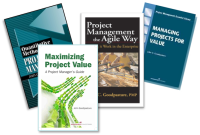
I've written a couple of books on project value; you can see the book covers at the end of this blog.
One of my themes in these books is a version of cybernetics:
Projects are transformative of disparate inputs into something of greater value. More than a transfer function, projects fundamentally alter the collective value of resources in a cybernetics way: the value of the output is all but undiscernible from an examination of inputs

But this posting is about asymmetry. Asymmetry is a different idea than cybernetics

"Value" is highly asymmetrical in many instances, without engaging cybernetics. One example cited by Steven Pinker is this:

Your refrigerator needs repair. $500 is the estimate. You groan with despair, but you pay the bill and the refrigerator is restored. But would you take $500 in cash in lieu of refrigeration? I don't know anyone who would value $500 in cash over doing without refrigeration for a $500 repair.

Of course there is the 'availability' bias that is also value asymmetrical:

"One in hand is worth two in the bush"

And there is the time displacement asymmetry:

The time-value of money; present value is often more attractive than a larger future value. The difference between them is the discount for future risk and deferred utility.
Let's not forget there is the "utility" of value:
$5 is worth much less to a person with $100 in their pocket than it is to a person with only $10

How valuable?
So when someone asks you "how valuable is your project", your answer is ...... ?


Like this blog? You'll like my books also! Buy them at any online book retailer!